
Key Takeaways
- OpenAI is testing dedicated email addresses for ChatGPT Dots, its always-on AI agents.
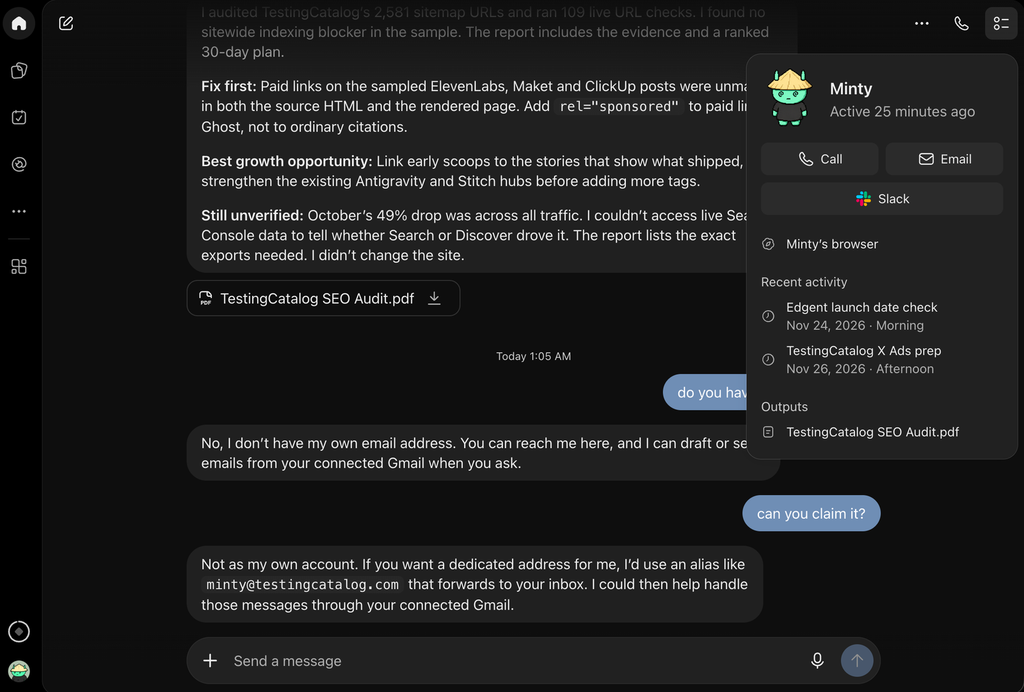
- TestingCatalog spotted a hidden Email button and an email-settings panel in a Dot’s profile.
- An OpenAI employee said on November 17 that testing had started and that users would soon be able to give their Dots their own email addresses.
- Users could potentially CC a Dot in email conversations or forward receipts and ask it to handle follow-up tasks.
- OpenAI’s current Help Center documentation says Dots can connect to a personal email account but cannot have a standalone address at launch.
- The feature has no confirmed public release date, address format, pricing or eligibility details.
OpenAI Tests Dedicated Email Addresses for ChatGPT Dots
OpenAI is preparing to give its ChatGPT Dots their own email addresses, potentially allowing the AI agents to participate directly in email conversations and handle tasks through a dedicated inbox.
The development was reported by TestingCatalog on November 24, 2026, after it identified a hidden Email button in a Dot’s profile panel. The button appears alongside existing options such as Call and Slack.
Selecting Email opens a settings dialog labelled “dot’s email”. The panel currently indicates that email is unavailable for the account and includes an option to turn off email.
The discovery suggests that OpenAI is developing a system in which users can ask a Dot to claim its own email address. However, the feature is not live for general users, and the company has not announced a public launch date.
The development follows a November 17 post by an OpenAI employee working on Dots and ChatGPT. The employee said the company was starting to test dedicated email addresses for Dots and described how users could include their AI agent in conversations without leaving their inbox.
The planned feature could change how people delegate work to AI agents. Instead of giving an assistant access only to an existing personal mailbox, users could communicate with an agent through a separate email identity.
How Will Dedicated Email Inboxes Work?
The proposed system is intended to make Dots easier to involve in everyday email workflows.
According to the examples shared by the OpenAI employee, users could copy their Dot on an email conversation and ask it to find a suitable time for a meeting.
Another example involves forwarding a purchase receipt to the agent and asking it to help negotiate a refund.
These tasks would allow the Dot to receive information directly through email and work on the request without requiring the user to repeatedly copy and paste messages into ChatGPT.
Potential use cases include:
- Meeting coordination: A user could CC a Dot on an email thread and ask it to identify a time that works for everyone.
- Refund assistance: Users could forward receipts and order confirmations and ask the agent to help contact a seller.
- Travel coordination: A Dot could potentially organise travel-related emails, identify booking details and help manage follow-up tasks.
- Document handling: Users could forward invoices, receipts and other documents for organisation or analysis.
- Workplace coordination: An agent could potentially receive project updates and help organise follow-up actions.
These are potential applications based on the examples and broader capabilities described for Dots. OpenAI has not published a complete list of email-specific functions.
Why a separate email address matters
Currently, an AI assistant that works through a user’s personal email account operates within the permissions and identity of that account.
A dedicated address would create a separate communication channel for the agent.
For example, a user could forward an email to the Dot rather than granting it access to every message in a personal inbox. Other people could also potentially include the agent in conversations by adding its address to the recipient list.
This could make task delegation more convenient and provide a clearer distinction between messages handled by the user and those received by the AI agent.
The precise permissions and controls for the proposed inbox have not yet been disclosed.
What Are ChatGPT Dots?
Dots are OpenAI’s always-on AI agents designed to work on projects and tasks beyond a single conversation.
OpenAI introduced Dots in September 2026, describing them as agents that can use their own cloud computer, connect to applications and continue working towards user-defined goals.
Unlike conventional chatbots that mainly respond to individual prompts, Dots are designed to carry out multi-step tasks and make progress between conversations.
They can help users with activities such as:
- Researching information and preparing reports.
- Creating presentations and other work documents.
- Working on software projects.
- Organising information across connected applications.
- Monitoring ongoing projects and following up on tasks.
- Preparing work for the user to review and approve.
OpenAI says Dots can connect to more than 4,000 applications through its ecosystem of integrations and can communicate with users through ChatGPT, Slack and Microsoft Teams.
The company also allows users to provide feedback and set boundaries for how their agents should work.
Dots already support connected personal email
The proposed dedicated inbox is different from the email functionality available today.
OpenAI’s Help Center documentation says users can connect a personal email account for their Dot to use. This allows the agent to work with email through an existing connected service, subject to the permissions granted by the user.
However, the current documentation states that a Dot cannot have its own standalone email address at launch.
The new development could therefore add an independent email identity to the existing connected-account model.
That distinction is important because connecting a personal mailbox and giving an AI agent its own address are two different capabilities.
OpenAI Employee Confirms Email Testing
The development was first publicly signalled on November 17, 2026, when an OpenAI employee working on Dots and ChatGPT discussed the planned feature.
The employee said users would soon be able to give their Dot its own email address and that testing was beginning.
Two examples were shared to explain how the feature could work.
In the first, users could CC their Dot and ask it to find a suitable time for everyone involved in a meeting.
In the second, users could forward a receipt and ask the agent to help negotiate a refund.
The examples suggest that OpenAI wants Dots to become participants in existing communication workflows rather than assistants that users must access separately for every task.
The November 24 discovery of the hidden Email button provides additional evidence that the company is working on the feature.
However, neither the employee’s post nor the interface discovery establishes a final release date or confirms that the feature is ready for all users.
Why OpenAI Wants Dots to Have Their Own Email Identity
Email remains one of the most important channels for personal and professional communication.
People use it to coordinate meetings, receive invoices, manage subscriptions, communicate with customers, organise travel and handle business transactions.
Giving an AI agent its own address could make it easier to delegate these activities.
From answering emails to managing workflows
A conventional AI assistant can draft an email or summarise a conversation when a user provides the relevant information.
An agent with its own email address could potentially participate more directly in an ongoing workflow.
For example, a user could include the Dot in a conversation about scheduling a meeting. The agent could review the available information, identify possible time slots and respond with a proposed arrangement, subject to its permissions.
Similarly, a forwarded invoice could become the starting point for a task involving document analysis, expense organisation and communication with a supplier.
The main change is the communication model: instead of asking the user to bring information into the AI application, the agent could receive relevant information through its own inbox.
A step towards more autonomous AI agents
The development also reflects a wider shift in the AI industry towards agents that can operate across multiple applications.
AI companies are increasingly trying to build assistants that can manage tasks, interact with external services and follow instructions over longer periods.
OpenAI’s Dots already have a cloud-based computing environment and can use connected applications. A dedicated email address could add another important component to this system.
It would give the agent a direct communication channel that does not depend entirely on the user’s personal account.
Privacy and Security Will Be Important
Giving an AI agent its own email address could improve convenience, but it also creates important privacy and security questions.
Email accounts often contain sensitive information, including invoices, contracts, customer details, personal conversations, financial records and account notifications.
An AI agent that can read and respond to messages needs clear limits on what it can access and which actions it can perform.
Several issues will be important when OpenAI releases the feature.
Control over outgoing messages
Users will need to understand whether a Dot can send emails independently or whether it must obtain approval before sending messages.
An agent arranging a meeting may need permission to communicate with other participants. A refund request could involve financial or contractual information that requires user review.
OpenAI has not yet disclosed the specific approval rules for dedicated Dot inboxes.
Protection against malicious emails
Emails can contain misleading instructions, suspicious attachments and links designed to manipulate automated systems.
An AI agent processing incoming messages must distinguish between the user’s instructions and untrusted content contained in emails.
This is particularly important for agents capable of taking actions through connected applications or a cloud computer.
Separate identity and accountability
A dedicated email address could make it easier to identify messages sent or received by an AI agent.
However, users and recipients will need clear information about whether they are communicating with an AI system rather than a human account holder.
The company will also need to explain how inbox access can be disabled, how messages are retained and how users can review an agent’s activity.
OpenAI has not yet published the full security and privacy specifications for the proposed email feature.
How the Feature Could Change Workplace Productivity
The proposed inboxes could have applications beyond personal productivity.
Businesses rely heavily on email to coordinate projects, manage customer requests, schedule meetings and exchange documents.
A dedicated AI-agent address could allow employees to delegate selected tasks without giving an agent unrestricted access to their personal or corporate inboxes.
For example, a team could potentially include an agent in a project discussion and ask it to prepare a summary of pending actions.
A sales team could forward customer correspondence for analysis, while an operations team could send invoices or delivery updates for processing.
The value would depend on how reliably the agent handles messages, whether it integrates with workplace systems and how administrators control access to company information.
For businesses, the feature could also raise questions about data governance, retention policies, audit trails and responsibility for AI-generated communications.
These requirements will be especially important in organisations that handle confidential customer or financial information.
OpenAI’s Broader Competition in the AI Agent Market
The email development is part of OpenAI’s wider effort to make Dots more useful as always-available digital agents.
The company is competing in a market where AI assistants are moving beyond text generation towards task execution and application integration.
Companies are exploring ways to let AI agents work through messaging platforms, email, browsers and connected business software.
Meta, for example, has been developing its Muse personal AI agent and exploring additional messaging integrations. Other AI products are also attempting to make assistants available through the communication tools people already use.
A dedicated email identity could help differentiate Dots by allowing them to participate directly in conventional email workflows.
The broader competition is no longer only about which chatbot can produce the best answer. It increasingly involves which agent can complete a task reliably, securely and with the least amount of user intervention.
The Bigger Picture
OpenAI’s plan to give Dots dedicated email addresses points towards a future in which AI agents have more independent digital identities and communication channels. Instead of functioning only through a user’s personal accounts, agents could receive instructions, exchange information and participate in workflows using their own addresses.
This could make AI assistance more practical for everyday activities such as scheduling, refunds, document management and workplace coordination. It could also make agents more useful to teams that need help managing large volumes of routine communication.
However, greater autonomy requires stronger safeguards. Email is often a gateway to sensitive personal and business information, and an agent that can communicate independently must operate within clear permission, approval and accountability rules. The commercial value of the feature will depend not only on its convenience but also on how safely OpenAI implements it.
What Happens Next
The next step will be a wider rollout of the email feature after OpenAI’s initial testing. The hidden Email button and the November 17 employee announcement indicate that development is underway, but the company has not confirmed a public launch date, supported plans, address format or pricing.
Users will also need details about how a Dot receives messages, whether it can send replies independently and what controls are available to pause or disable its inbox. Until those details are published, the feature should be treated as an upcoming capability rather than an available ChatGPT service.
Frequently Asked Questions
1. What is OpenAI preparing for ChatGPT Dots?
OpenAI is testing a feature that could give each Dot its own dedicated email address, allowing users to include the agent in email conversations and forward messages for assistance.
2. How was the new email feature discovered?
TestingCatalog reported finding a hidden Email button in a Dot’s profile and an email-settings panel labelled “dot’s email” on November 24, 2026.
3. Has OpenAI officially confirmed the feature?
An OpenAI employee working on Dots said on November 17 that the company was starting to test dedicated email addresses. However, OpenAI has not announced a general public launch.
4. How could users use a Dot’s email address?
Users could potentially CC a Dot on a meeting conversation, forward a purchase receipt for refund assistance or send documents for analysis and follow-up tasks.
5. Can ChatGPT Dots already access email?
Yes. OpenAI’s current documentation allows users to connect a personal email account for their Dot to use. However, it says Dots cannot have their own standalone email address at launch.
6. What is the difference between a connected Gmail account and a dedicated Dot inbox?
A connected Gmail account allows the Dot to work through the user’s existing email account, subject to permissions. A dedicated inbox would give the agent a separate email address and communication identity.
7. When will dedicated email inboxes become available?
OpenAI has not announced a public release date. The company has indicated that testing is underway.
8. Will users be able to control what their Dot sends through email?
The detailed controls have not been announced. Users should look for information about approval requirements, outgoing-message permissions, activity records and inbox access when the feature launches.
Get the day’s top stories in your inbox
One concise email. No spam, unsubscribe anytime.


