
Perplexity has introduced a new developer tool that could change how AI agents collect and respond to information from the internet. Its Monitor API continuously tracks developments across the web or changes to selected webpages, then sends relevant updates to applications through automated webhooks.
Announced on November 16, 2026, the service is designed to eliminate the need for developers to build and maintain their own recurring search systems, duplicate filters and webpage change detectors. Instead of repeatedly asking an AI system to search for information, developers can configure a monitor once and let it run automatically. The API is available through Perplexity’s existing developer platform, with pricing starting at $1 per 1,000 successful web-monitor runs.
Key Takeaways
- Continuous web monitoring: The Monitor API tracks developments across web and news search results on a recurring schedule.
- Two monitoring modes: Developers can monitor an entire topic or track changes across up to 10 specific webpages.
- Automated relevance filtering: Perplexity Decider evaluates results for relevance, source legitimacy, novelty and freshness.
- Frequent monitoring: Checks can run every 15 minutes, hourly, daily, weekly or on a custom schedule.
- Low starting cost: Web monitors cost $1 per 1,000 successful runs, while page monitors cost $1 per 1,000 URLs fetched.
- AI agent integration: Signed webhooks deliver relevant changes directly to applications and automated workflows.
What Is Perplexity’s Monitor API?
The Monitor API is a web-monitoring service that allows developers to create automated systems for tracking information over time.
Traditional search APIs generally respond when an application sends a query. If a company wants to know whenever a competitor changes its pricing, announces a new product or publishes an important update, developers must repeatedly run searches and compare the results.
This requires additional infrastructure to schedule searches, remove duplicate results, identify meaningful changes and deliver notifications.
Perplexity wants to handle these operations through a single API.
Developers can define what they want to monitor using a search query or a list of webpages. They can also provide a natural-language goal explaining what qualifies as an important update.
Once configured, the monitor runs according to its schedule and sends relevant discoveries to the developer’s application through a webhook.
The approach is particularly useful for AI agents that need access to current information without constantly performing searches.
Two Ways to Monitor the Internet
The Monitor API supports two different monitoring methods. Each is designed for a different information-tracking requirement.
1. Web Monitor: Track New Developments Across the Internet
Web Monitor searches across Perplexity’s web and news results to identify new developments involving a topic, company or question.
For example, an investment research company could create a monitor for funding announcements involving artificial intelligence infrastructure startups.
It could define its goal as identifying companies that have announced Series A or Series B funding rounds.
The monitor would periodically search for new information and send qualifying discoveries to the connected application.
Potential applications include:
- Tracking startup funding announcements.
- Monitoring company acquisitions and leadership changes.
- Following product launches and technology announcements.
- Tracking regulatory developments.
- Identifying new market developments for research teams.
This mode is designed for situations where developers want to discover new information from multiple sources rather than monitor a single known webpage.
2. Page Monitor: Track Changes to Specific Websites
Page Monitor focuses on webpages that developers already know they want to follow.
It can monitor up to 10 specified URLs, including:
- Competitor pricing pages.
- Product documentation.
- Software changelogs.
- Government policy pages.
- Regulatory announcements.
- Company product and service pages.
The system first saves a baseline version of each webpage. During subsequent checks, it compares the latest version with the stored version and generates a text difference showing what changed.
For example, a software company could monitor a competitor’s pricing page. If the competitor changes subscription prices or introduces a new plan, the API can detect the modification and send the difference to the connected application.
Unlike Web Monitor, which discovers new developments through search, Page Monitor follows specific webpages selected by the developer.
Perplexity Decider Filters Out Irrelevant Updates
One of the central features of the Monitor API is Perplexity Decider, which evaluates potential updates before they reach an application.
Continuous monitoring can generate large volumes of information. Without filtering, an AI agent could receive repeated announcements, outdated articles, irrelevant search results and minor webpage changes.
Perplexity addresses this problem by evaluating results against the goal defined by the developer.
For Web Monitor, every result must pass four checks:
- Relevance: Is the information related to the developer’s monitoring goal?
- Source legitimacy: Does the information come from a credible source?
- Novelty: Does it contain genuinely new information?
- Freshness: Is the information recent enough to qualify?
Page Monitor uses a different evaluation process, checking whether a detected webpage change is meaningful for the specified goal.
An update is delivered only when it meets the required thresholds. Each notification also includes a confidence score.
Developers can adjust individual thresholds and modify the monitoring goal without creating an entirely new monitor.
This gives businesses more control over how sensitive their monitoring systems should be.
Automated Scheduling and Webhooks
The Monitor API is designed to operate continuously without requiring developers to manually initiate every search.
Available scheduling options include:
| Monitoring frequency | Availability |
|---|---|
| Every 15 minutes | Supported |
| Hourly | Supported |
| Daily | Supported |
| Weekly | Supported |
| Custom schedule | Supported through cron |
The system also manages duplicate detection across monitoring runs. This means developers do not need to build an entirely separate mechanism to identify information that has already been delivered.
When an important update is found, Perplexity sends it through a signed webhook.
Webhooks allow one application to automatically communicate with another when a specific event occurs.
For example, when a monitor discovers that a competitor has changed its pricing, the webhook could activate an AI agent that analyses the new prices, compares them with the company’s existing products and prepares a competitive intelligence report.
Similarly, a funding announcement could trigger additional research about the company, its investors and its business strategy.
Developers can pause, resume or manually trigger monitors through the API or Perplexity’s API Console.
The service also supports automatic retries when temporary webhook delivery problems occur.
Perplexity Claims Strong Results in Its Internal Benchmark
Perplexity also shared the results of an internal evaluation comparing its monitoring capabilities with other Search API providers.
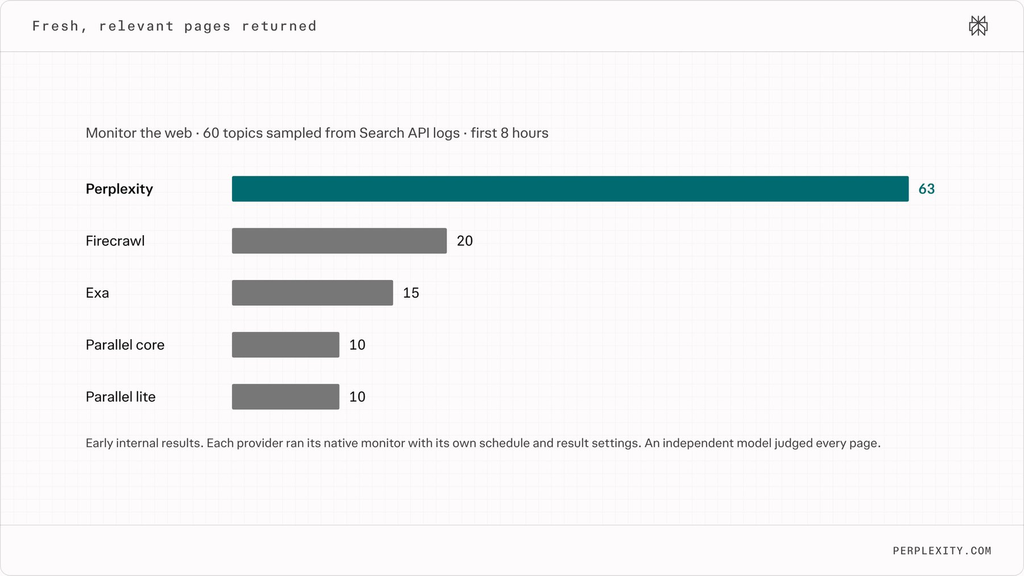
The company tested its Monitor system across 60 topics drawn from production Search API queries. These included company news, technology releases and regulatory developments.
Each monitor tracked its assigned topic for eight hours. A separate model then evaluated the results for relevance and publication timing.
Perplexity said its system delivered the freshest and most relevant results across the widest range of topics in the evaluation.
The company also reported that several results discovered by its Monitor API were not returned by other providers.
However, the published announcement does not provide a complete independent evaluation or detailed provider-by-provider results. The findings should therefore be treated as Perplexity’s own benchmark claims rather than an independently established industry ranking.
The evaluation nevertheless highlights the company’s broader ambition to make continuous information discovery easier for developers building autonomous applications.
Monitor API Pricing: How Much Does It Cost?
Perplexity has introduced relatively straightforward usage-based pricing for its monitoring service.
| Monitoring type | Price |
|---|---|
| Web Monitor | $1 per 1,000 successful runs |
| Page Monitor | $1 per 1,000 URLs fetched |
The pricing structures are different because a single Page Monitor run can fetch multiple webpages.
For example, consider a Web Monitor that checks a topic every hour for 30 days.
That represents approximately 720 successful runs.
At the announced rate, the monitoring cost would be:
720 ÷ 1,000 × $1 = $0.72
A Page Monitor tracking 10 webpages every hour for the same 30-day period would generate approximately 7,200 URL fetches.
Its corresponding cost would be:
7,200 ÷ 1,000 × $1 = $7.20
These examples use the published unit rates and assume every scheduled check or URL fetch is successfully billed. They exclude any additional application, infrastructure or downstream AI-model costs.
The Monitor API is available through the same API key used for Perplexity’s Search, Context and Agent APIs.
How Businesses Could Use the Monitor API
Perplexity has identified several potential business applications for its monitoring technology.
Sales and Business Development
Sales teams can monitor funding announcements, executive appointments and product launches involving potential customers.
When a relevant development occurs, an AI agent could research the company, update customer relationship management systems and prepare personalised outreach.
Financial Research
Investment research teams can track quarterly earnings, acquisitions, changes in financial guidance and adverse company news.
An AI agent could then summarise the developments and identify possible implications for an analyst’s investment thesis.
Competitive Intelligence
Companies can continuously monitor competitor pricing, product releases, feature updates and software changelogs.
This could help businesses identify market changes without requiring employees to manually inspect competitor websites.
Regulatory Monitoring
Compliance teams can monitor government announcements, regulatory guidance and policy updates.
When a relevant change appears, an AI agent could prepare a summary and forward it to the appropriate team for review.
These applications illustrate how monitoring can become part of an automated business workflow rather than a separate research activity.
The Bigger Picture
Perplexity’s Monitor API reflects a broader shift in the AI industry from systems that respond to individual prompts towards agents that continuously observe information and act when something important happens.
Traditional AI search is largely reactive. A user or application submits a question, receives information and decides what to do next.
Continuous monitoring introduces a different model. An agent can watch a particular market, company, website or regulatory area and receive information when meaningful developments occur.
This creates opportunities for applications that operate with less manual supervision. Instead of repeatedly checking whether something has changed, businesses can build workflows that respond automatically to new information.
It also gives Perplexity an additional opportunity to expand its developer business. Search APIs provide information when requested, while monitoring services can become an ongoing infrastructure layer for applications that depend on fresh data.
However, the usefulness of such systems will depend on the quality of their sources, the accuracy of relevance filtering and the reliability of notifications. A monitoring system that misses an important announcement or sends too many irrelevant alerts can still create problems for businesses.
What Happens Next?
The immediate opportunity for Perplexity is to attract developers building AI agents for research, sales, financial analysis, competitive intelligence and compliance. Its combination of scheduled searches, webpage comparisons, automated filtering and webhook delivery gives developers a ready-made monitoring layer without requiring them to maintain the entire system themselves. The service is already available through the Perplexity API platform, although adoption will depend on how reliably it performs across different real-world monitoring requirements.
The larger question is whether continuous monitoring becomes a standard capability for autonomous AI agents. As more businesses move towards automated research and decision-support workflows, agents will need to recognise important changes rather than simply answer questions. Perplexity’s Monitor API is an attempt to provide that capability, turning web search from a one-time interaction into an ongoing information pipeline.
Frequently Asked Questions
1. What is Perplexity Monitor API?
Perplexity Monitor API is a developer service that continuously monitors web search topics or selected webpages and sends relevant updates to applications through webhooks.
2. When was the Monitor API launched?
Perplexity announced the Monitor API on November 16, 2026.
3. How many webpages can it monitor?
Page Monitor supports up to 10 selected webpages in a single monitor.
4. How frequently can the API check for updates?
It supports intervals such as every 15 minutes, hourly, daily and weekly, along with custom cron schedules.
5. How much does Perplexity Monitor API cost?
Web monitoring costs $1 per 1,000 successful runs. Page monitoring costs $1 per 1,000 URLs fetched.
6. What is Perplexity Decider?
Perplexity Decider evaluates potential updates against the developer’s monitoring goal. It checks relevance, source legitimacy, novelty and freshness for web results.
7. Can developers connect the Monitor API to AI agents?
Yes. The API sends updates through signed webhooks, which can trigger workflows in connected applications and AI agents.
8. Is the Monitor API available to developers?
Yes. It is available through Perplexity’s API and API Console, using the same API key as its Search, Context and Agent APIs.
Get the day’s top stories in your inbox
One concise email. No spam, unsubscribe anytime.


