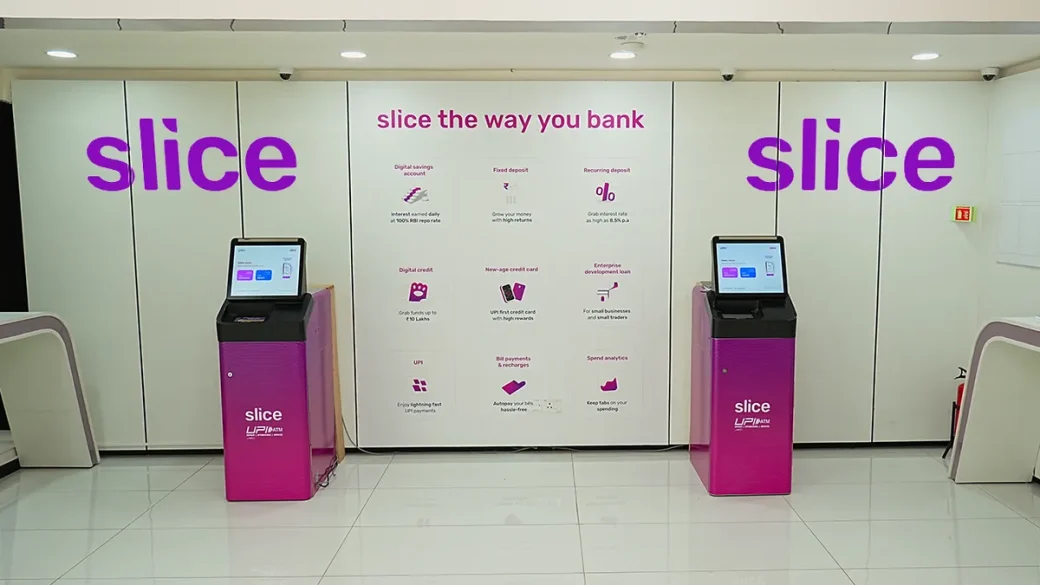
Digital banking platform Slice has started FY27 on a strong financial footing, reporting a net profit of ₹50.9 crore in the first quarter, more than its entire profit for FY26.
The Q1 performance comes after Slice achieved its first full year of profitability as a bank in FY26, marking a significant turnaround for the fintech company following its transition into banking.
Slice’s income also increased 38.6% year-on-year to ₹511 crore during the June quarter, according to data reported by Entrackr.
The results indicate that Slice is entering FY27 with improving profitability, stronger income generation and a growing focus on its digital banking business.
Slice posts ₹50.9 crore profit in Q1 FY27
Slice reported a net profit of ₹50.9 crore for the quarter ended June 2026.
The result is particularly significant because Slice’s entire profit for FY26 was ₹48.4 crore.
In other words, the fintech-turned-bank generated more profit in just three months of FY27 than it did during the entire previous financial year.
| Metric | Q1 FY27 |
|---|---|
| Net profit | ₹50.9 crore |
| FY26 full-year profit | ₹48.4 crore |
| Q1 income | ₹511 crore |
| YoY income growth | 38.6% |
SLICE PROFITABILITY

FY26
Full-year profit
₹48.4 crore
        ↓
Q1 FY27
3-month profit
₹50.9 crore
        ↓
Q1 profit exceeds
entire FY26 profit
The numbers highlight the pace at which Slice’s profitability has improved since completing its transition into a small finance bank.
Income rises 38.6% to ₹511 crore
Slice’s income increased 38.6% year-on-year to ₹511 crore in Q1 FY27.
The growth indicates that the company is expanding its revenue base while simultaneously improving profitability.
SLICE INCOME

Q1 FY26
Lower base
      ↓
Q1 FY27
₹511 crore
      ↓
+38.6% YoY
Revenue growth combined with profitability is particularly important for a fintech company that has historically focused heavily on customer acquisition and technology-led expansion.
A major turnaround for Slice
Slice’s latest numbers represent a significant change from its earlier business trajectory.
The company was initially known as a fintech focused on consumer credit and digital financial products.
It later moved into banking after merging with North East Small Finance Bank, giving it access to a regulated banking platform.
The transition fundamentally changed Slice’s business model.
EARLIER SLICE

Fintech
   ↓
Credit / financial products
   ↓
Growth focus


NEW SLICE

Fintech
   +
Banking licence
   ↓
Deposits
+
Loans
+
Payments
+
Digital banking
The company is now attempting to build a broader digital banking franchise rather than remaining solely a fintech lending platform.
FY26 was Slice’s first profitable year as a bank
Slice achieved full-year profitability in FY26, reporting a profit of ₹48.4 crore.
That milestone was important because the company had spent years investing heavily in customer acquisition, technology and financial products before moving toward sustainable profitability.
SLICE

Fintech growth
      ↓
Banking transition
      ↓
Cost discipline
      ↓
FY26 profitability
      ↓
Q1 FY27
₹50.9 crore profit
The Q1 result suggests the improvement was not limited to a single full-year turnaround.
Q1 profit already exceeds FY26 profit
One of the strongest signals from the results is the comparison between FY26 and Q1 FY27.
Slice earned ₹48.4 crore during all of FY26.
It earned ₹50.9 crore during Q1 FY27 alone.
That represents a significant acceleration in quarterly profitability.
PROFIT COMPARISON

FY26
₹48.4 crore
████████████████████

Q1 FY27
₹50.9 crore
█████████████████████
If profitability remains at a similar level through the remaining quarters, Slice could potentially deliver substantially higher annual profits in FY27.
However, quarterly results can fluctuate, so the Q1 figure should not automatically be extrapolated to the full year.
Why the banking transition matters
Becoming a bank gives Slice access to a broader set of financial products.
A bank can accept deposits and use those funds as part of its lending business, subject to regulatory requirements.
CUSTOMER
   ↓
Deposit
   ↓
Slice bank
   ↓
Loans / financial products
   ↓
Interest income
This creates a different economic model from a fintech that primarily depends on partnerships with banks and financial institutions.
Slice’s digital banking strategy
Slice is positioning itself as a digital-first bank, with technology playing a central role in customer acquisition, payments and financial services.
The company is seeking to combine its fintech heritage with the capabilities available through a regulated banking structure.
DIGITAL-FIRST BANK

Technology
   +
Banking licence
   +
Digital customers
   +
Financial products
   ↓
Slice
The strategy is aimed at building a banking experience that is more technology-driven than traditional branch-based banking.
Profitability is becoming a bigger focus
The latest numbers also reflect a broader shift in India’s fintech industry.
During the rapid growth phase of the fintech sector, companies often prioritised:
- Customer acquisition
- Transaction volumes
- Market share
- Product expansion
- Technology investment
The focus has increasingly shifted toward:
- Sustainable revenue
- Cost efficiency
- Credit quality
- Profitability
- Regulatory compliance
OLD FINTECH MODEL

Growth
  ↓
Customers
  ↓
Market share


NEW PRIORITY

Growth
+
Revenue
+
Cost control
+
Credit quality
  ↓
Profitability
Slice’s Q1 performance fits into this broader industry transition.
What drove the improvement?
Slice’s profitability is linked to the expansion of its banking operations and improving operating economics.
As the business scales, a larger customer and asset base can potentially allow fixed technology and infrastructure costs to be spread across more revenue.
MORE SCALE
   ↓
Higher income
   +
Better cost absorption
   ↓
Operating leverage
   ↓
Higher profitability
However, maintaining profitability will depend on the quality of its loan book, funding costs and operating expenses.
Lending remains an important part of the model
For a small finance bank, lending is a critical source of revenue.
Slice can use its banking platform to provide credit products to customers while earning interest income.
DEPOSITORS
   ↓
Bank
   ↓
Lending
   ↓
Interest income
   ↓
Bank profitability
But lending also creates credit risk.
If borrowers default, the bank needs to recognise losses and increase provisions.
Credit quality will be crucial
Slice’s future profitability cannot be judged only by income and net profit.
Investors and analysts will also need to watch:
- Gross non-performing assets
- Net NPAs
- Provisioning
- Loan growth
- Credit costs
- Deposit growth
- Capital adequacy
BANK PROFITABILITY

Loan growth
   +
Interest income
   -
Credit losses
   -
Operating costs
   ↓
Net profit
Strong loan growth without adequate credit discipline could eventually hurt profitability.
Deposits are another important growth area
As a bank, Slice also needs to build a stable deposit base.
Deposits provide a source of funding for lending and are central to the economics of a banking business.
CUSTOMERS
   ↓
Deposits
   ↓
Bank funding
   ↓
Loans
   ↓
Interest income
The ability to attract low-cost deposits could become one of Slice’s most important long-term competitive advantages.
Digital banking could reduce distribution costs
One potential advantage of Slice’s model is its digital-first approach.
Traditional banks maintain large branch networks and physical infrastructure.
Digital banks can potentially acquire and serve customers with lower physical distribution requirements.
TRADITIONAL BANK

Branches
+
Staff
+
Physical infrastructure
+
Digital channels


DIGITAL-FIRST BANK

App
+
Technology
+
Digital customer service
Lower distribution costs can potentially support competitive pricing and better margins.
However, digital banks still need significant spending on technology, cybersecurity, compliance and customer support.
Slice faces intense competition
The Indian digital banking and fintech market is highly competitive.
Slice competes indirectly with:
- Traditional banks
- Small finance banks
- Fintech companies
- Digital payment platforms
- Consumer-credit platforms
- Neobanks and digital financial services providers
INDIAN DIGITAL FINANCE

Traditional banks
       +
Small finance banks
       +
Fintechs
       +
Payment platforms
       ↓
Highly competitive market
Slice therefore needs to maintain a strong product proposition while controlling costs.
The merger changed Slice’s trajectory
Slice’s merger with North East Small Finance Bank was a major turning point.
It allowed the fintech company to operate within a regulated banking framework and expand beyond its earlier fintech model.
SLICE FINTECH
      +
NORTH EAST SMALL FINANCE BANK
      ↓
Banking platform
      ↓
Digital-first bank
The latest profitability numbers suggest that the transition is beginning to produce financial benefits.
FY27 could become a stronger year
The Q1 result creates a strong starting point for FY27.
Slice has already generated ₹50.9 crore in profit.
If the company can maintain profitability while expanding its customer base and banking operations, FY27 could become an important year in its evolution.
FY27

Q1
₹50.9 crore profit
      ↓
Q2
      ↓
Q3
      ↓
Q4
      ↓
Potentially stronger full-year profitability
Actual annual performance will depend on the remaining three quarters.
Income growth remains important
Profitability alone is not enough for a growing financial institution.
Slice needs to continue expanding its income base.
The 38.6% year-on-year increase to ₹511 crore indicates that the company is currently achieving both revenue growth and profitability.
Q1 FY27

Income
+38.6%
      +
Profit
₹50.9 crore
      ↓
Growth + profitability
Maintaining this combination will be important as the company scales.
Slice’s strategy is moving beyond payments
The company’s future ambitions appear broader than payments.
As a bank, Slice can build products across:
- Deposits
- Loans
- Payments
- Cards
- Savings
- Digital banking
- Other financial services
SLICE BANK

Deposits
Loans
Payments
Cards
Savings
Digital services
       ↓
One banking ecosystem
This could increase customer lifetime value if customers use multiple products.
Cross-selling could become important
Once customers have an account with Slice, the bank can potentially offer additional financial products.
For example:
CUSTOMER
   ↓
Savings account
   ↓
UPI / payments
   ↓
Credit
   ↓
Card
   ↓
Other financial products
The more products a customer uses, the greater the potential revenue per customer.
Technology remains a core differentiator
Slice’s fintech origins give it experience in building mobile-first financial products.
The company can use technology to simplify onboarding, payments, credit assessment and customer engagement.
DATA
 ↓
TECHNOLOGY
 ↓
PERSONALISED PRODUCTS
 ↓
CUSTOMER EXPERIENCE
 ↓
ENGAGEMENT
However, technology alone is not enough in banking.
Trust, regulatory compliance and financial stability are equally important.
Regulatory oversight is now greater
As a regulated bank, Slice operates under the supervision of the Reserve Bank of India (RBI) and must comply with banking regulations.
That includes requirements related to:
- Capital
- Liquidity
- Customer protection
- KYC
- Risk management
- Lending
- Governance
SLICE BANK
      ↓
RBI regulation
      ↓
Capital + liquidity
+
Risk management
+
Customer protection
This adds compliance costs but also provides a regulated framework that can increase customer trust.
Profitability does not eliminate risk
Despite the strong Q1 result, Slice remains exposed to the normal risks faced by financial institutions.
These include:
- Credit defaults
- Funding costs
- Interest-rate changes
- Competition
- Regulatory changes
- Cybersecurity threats
- Technology failures
BANKING RISKS

Credit
Funding
Regulation
Technology
Competition
   ↓
Need strong risk management
The company’s ability to manage these risks will determine whether its recent profitability is sustainable.
The wider fintech sector is entering a new phase
Slice’s turnaround reflects a broader trend among Indian fintech companies.
After years of aggressive expansion, investors and management teams are increasingly demanding sustainable business models.
Companies are being judged not only on:
How many customers do you have?
but also:
How much money do those customers generate?
and:
Can the business remain profitable while scaling?
FINTECH 1.0
Growth at any cost
      ↓
FINTECH 2.0
Growth + unit economics
      ↓
FINTECH 3.0
Growth + profitability + regulation
Slice’s transformation into a bank places it directly within this new phase.
Why Q1 FY27 matters
The quarter matters for three reasons.
1. Profit exceeded FY26 full-year profit
₹50.9 crore in Q1 versus ₹48.4 crore for all of FY26.
2. Income grew strongly
Income increased 38.6% year-on-year to ₹511 crore.
3. Profitability followed a full-year turnaround
The company had only recently achieved its first profitable full financial year as a bank.
Together, these figures suggest that Slice’s financial turnaround is gaining momentum.
What to watch in the next quarters
The next three quarters will provide a clearer picture of whether the Q1 performance can be sustained.
Key metrics to monitor include:
| Metric | Why it matters |
|---|---|
| Net profit | Shows overall profitability |
| Income growth | Measures business expansion |
| Deposits | Indicates funding strength |
| Loan growth | Shows lending expansion |
| Gross NPA | Measures asset quality |
| Credit costs | Shows lending losses |
| Capital adequacy | Indicates financial resilience |
| Operating expenses | Determines scalability |
NEXT THREE QUARTERS

Income
   +
Deposits
   +
Loans
   +
Credit quality
   +
Cost control
   ↓
Sustainable profitability
Could Slice become a major digital bank?
The Q1 results strengthen Slice’s case for becoming a meaningful player in India’s digital banking market.
But scale alone will not determine success.
The company needs to demonstrate that it can:
- Grow deposits
- Expand lending responsibly
- Maintain asset quality
- Keep customer acquisition costs under control
- Generate recurring income
- Remain profitable
- Comply with banking regulations
DIGITAL BANK SUCCESS

Scale
+
Profitability
+
Credit quality
+
Deposits
+
Technology
+
Trust
=
Sustainable bank
Slice has made progress on profitability, but the other elements will become increasingly important.
What the numbers mean for the fintech ecosystem
Slice’s performance is significant beyond the company itself.
A fintech that successfully transitions into a profitable bank could provide a blueprint for other technology companies seeking deeper participation in India’s regulated financial system.
FINTECH
   ↓
Banking licence / merger
   ↓
Digital banking
   ↓
Scale
   ↓
Profitability
The model demonstrates how technology companies can combine digital distribution with regulated banking infrastructure.
Key takeaways
1. Slice reported a net profit of ₹50.9 crore in Q1 FY27, according to Entrackr.
2. The Q1 profit exceeded Slice’s entire FY26 profit of ₹48.4 crore.
3. Slice’s income rose 38.6% year-on-year to ₹511 crore in Q1 FY27.
4. FY26 was Slice’s first full year of profitability as a bank, marking an important turnaround for the company.
5. The company’s transformation from a fintech into a small finance bank has broadened its business model beyond its earlier consumer-finance focus.
6. Slice can now build a wider banking ecosystem around deposits, lending, payments and other financial services.
7. Maintaining credit quality and controlling operating costs will be critical as the bank scales.
8. The strong Q1 performance gives Slice a strong starting point for FY27, but three more quarters are needed to determine whether the profitability level is sustainable.
9. Slice’s performance reflects a broader shift in India’s fintech sector from growth-at-all-costs toward profitability and sustainable unit economics.
10. The company’s long-term success will depend on combining digital technology with strong banking fundamentals, including deposits, credit quality, capital and regulatory compliance.
Conclusion
Slice has delivered a strong start to FY27, with ₹50.9 crore in net profit during the June quarter, exceeding the ₹48.4 crore profit it generated during the entire FY26.
The company’s income also rose 38.6% year-on-year to ₹511 crore, showing that the improvement is being accompanied by meaningful business growth rather than profitability coming solely from cost reductions.
The result is particularly significant because FY26 was Slice’s first full year of profitability as a bank.
That makes the Q1 number an important test of whether the company’s turnaround can continue.
So far, the signs are encouraging.
Slice has moved from being primarily viewed as a fintech company focused on digital financial products toward a broader digital banking model.
Its banking platform gives it access to deposits and lending, while its technology background provides the potential to deliver financial products through a digital-first customer experience.
This combination could give Slice an opportunity to compete with both traditional banks and newer fintech companies.
But profitability alone does not guarantee long-term success.
The next stage of Slice’s growth will be considerably more demanding.
The company will need to grow its deposit base, expand lending without compromising asset quality, manage credit costs and keep operating expenses under control.
That is because banking is fundamentally different from a typical technology business.
A fintech can scale customers quickly, but a bank must also manage liquidity, capital, credit risk and regulatory requirements.
The company’s transformation following its merger with North East Small Finance Bank therefore represents both an opportunity and a responsibility.
If Slice can maintain strong income growth while keeping credit quality healthy, its recent profitability could mark the beginning of a much larger banking franchise.
The ₹50.9-crore Q1 profit is already a strong signal.
But the real test will be whether Slice can repeat that performance quarter after quarter while continuing to expand its customer and deposit base.
For India’s broader fintech industry, Slice’s performance also offers an important lesson.
The sector is moving away from the era when customer growth and valuation were the primary measures of success.
The new benchmark is increasingly growth plus profitability plus sustainable economics.
Slice’s latest numbers suggest it is beginning to meet that benchmark.
If the momentum continues through FY27, the company could emerge as one of India’s more notable examples of a fintech successfully transitioning into a profitable digital banking business.
Get the day’s top stories in your inbox
One concise email. No spam, unsubscribe anytime.


