
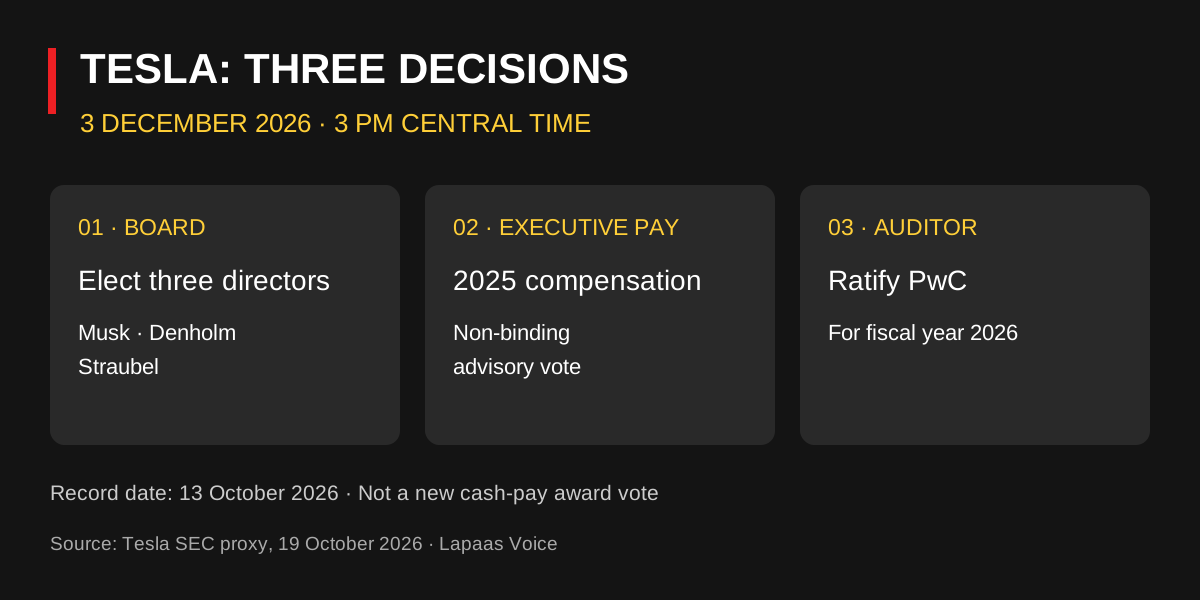
Tesla shareholders will vote on Elon Musk’s re-election to the company’s board and an advisory resolution concerning his reported $158.36 billion compensation for 2025 at the electric vehicle maker’s annual meeting on December 3, 2026. The company filed its proxy statement with the US Securities and Exchange Commission (SEC) on October 19, outlining three principal voting items. Shareholders will also decide on the re-election of board chair Robyn Denholm and director JB Straubel, alongside the ratification of PricewaterhouseCoopers (PwC) as Tesla’s auditor for 2026.
The meeting comes as Tesla continues to rely on Musk’s leadership while expanding its ambitions in artificial intelligence, robotics, autonomous driving and electric vehicles. The compensation figure has attracted attention because it is unusually large, but it does not represent cash paid directly to Musk. Tesla’s filing reports compensation primarily in stock awards, including a performance-based award whose value depends on meeting demanding milestones. The December vote will therefore bring renewed attention to executive compensation, board oversight and the relationship between shareholder approval and Tesla’s long-term strategy.
Key Takeaways
- Shareholder meeting: Tesla’s annual meeting is scheduled for December 3, 2026.
- Musk’s re-election: Shareholders will vote on whether Elon Musk should serve another three-year board term.
- Reported compensation: Tesla disclosed approximately $158.36 billion in compensation for Musk for 2025, primarily in stock awards.
- Other board votes: Chair Robyn Denholm and director JB Straubel are also seeking re-election.
- Auditor vote: Shareholders will vote on ratifying PwC as Tesla’s auditor for 2026.
- No SpaceX merger vote: Tesla’s current proxy statement contains no proposal to approve a merger with SpaceX.
- Voting eligibility: The record date for the meeting was October 13, 2026.
What Will Tesla Shareholders Vote On?
Tesla’s proxy statement sets out three principal matters for the December 3 annual meeting. The first is the election of three directors, the second is an advisory vote on executive compensation for 2025, and the third is the ratification of PwC as the company’s independent auditor.
| Proposal | What shareholders will decide |
|---|---|
| Board elections | Whether to re-elect Elon Musk, Robyn Denholm and JB Straubel |
| Executive compensation | Whether to support Tesla’s reported 2025 executive pay through a non-binding advisory vote |
| Auditor appointment | Whether to ratify PwC as Tesla’s auditor for 2026 |
Tesla’s board has recommended that shareholders vote in favour of all three proposals. The director terms would run for another three years, extending to 2029.
The compensation vote is advisory rather than a direct contractual approval of every element of Musk’s pay. Nevertheless, the result could provide an indication of shareholder sentiment toward Tesla’s executive compensation practices.
The annual meeting will take place at Gigafactory Texas in Austin, with a virtual option available to shareholders. Tesla has said that in-person attendance will be limited.
Why Is Elon Musk’s Re-election Important?
Musk has been central to Tesla’s identity and strategy, overseeing its expansion from an electric vehicle manufacturer into a business pursuing autonomous driving, robotics and AI-related technologies.
His continued leadership is also a governance question for investors. Shareholders must assess the value of his involvement alongside concerns about management attention, oversight and the company’s dependence on a high-profile executive.
Tesla has asked investors to re-elect Musk for another three-year term. Board chair Robyn Denholm and director JB Straubel are also standing for re-election, making the vote a decision about the composition and continuity of Tesla’s board.
The company’s board has argued that experienced leadership is important as Tesla develops its technology and business model. Investors, however, may assess that position differently depending on their views about Tesla’s performance, strategic priorities and governance arrangements.
The vote will not by itself settle every question about Musk’s role at Tesla. It will determine whether shareholders support his continued board membership under the terms presented in the proxy statement.
Tesla’s $158.36 Billion Compensation Figure Explained
Tesla’s proxy statement reports Musk’s total compensation for 2025 at approximately $158.36 billion. The figure is largely associated with stock awards, rather than a cash salary or a transfer of that amount into Musk’s bank account.
The company’s compensation disclosures include a 2025 CEO Performance Award covering approximately 423.7 million restricted shares. The reported value reflects compensation-accounting assumptions and the potential value of awards under specified conditions. It should not be interpreted as cash already received or as an unconditional payment.
Tesla’s performance award is structured around demanding operational and market-capitalisation targets. Its 12 tranches require Tesla to reach market-value milestones ranging from $2 trillion to $8.5 trillion, alongside operational objectives.
According to Reuters’ reporting on the proxy filing, none of the 12 tranches of the $1 trillion performance award had been earned at the time of the disclosure. The award’s ultimate value and vesting depend on whether the applicable conditions are met.
This distinction is important because headline compensation figures can combine different types of awards and accounting valuations. The value reported for a particular year does not necessarily equal the amount an executive has received in cash, the market value of shares currently owned, or the value that will ultimately be realised.
How stock-based compensation works
Companies often use stock awards to connect executive rewards with long-term business performance. Instead of receiving the entire amount as cash, an executive may receive shares or rights to shares that vest only when specified conditions are satisfied.
Such arrangements can align an executive’s financial interests with shareholders when the business performs well. However, they can also create concerns about dilution, the difficulty of measuring future award values and whether performance targets sufficiently reflect sustainable business results.
Tesla’s shareholders will be asked to express their view on the company’s reported 2025 executive compensation. The advisory nature of the vote means it is a governance signal rather than a direct replacement for the contractual terms governing the award.
The Difference Between the $158 Billion Figure and Musk’s $1 Trillion Award
The two figures refer to different things and should not be used interchangeably.
The $158.36 billion figure is the compensation reported for Musk for 2025 in Tesla’s proxy statement. The separate performance award has been described as a $1 trillion package because of its potential value if the specified conditions are achieved.
The performance award is tied to market-capitalisation and operational milestones. It does not mean Musk has already received $1 trillion, and the $158.36 billion reported figure does not mean that the company has paid him that amount in cash.
This distinction matters when comparing executive pay across companies. Compensation disclosures may reflect the accounting value of awards, the date on which awards were granted and assumptions about whether performance targets will be met. Cash salary, realised proceeds from share sales and the reported value of stock awards are separate measures.
For Tesla investors, the relevant questions include whether the incentive structure is appropriate, how much shareholder dilution could result, and whether the targets support durable business performance.
What Happens to Tesla’s Board and Corporate Governance?
The December vote also places Tesla’s board structure under scrutiny. Board directors are responsible for oversight of management, executive compensation, risk management and the interests of shareholders.
Denholm, who chairs the board, and Straubel, a co-founder of Tesla, are both seeking another three-year term. The board has recommended re-electing all three nominees.
Tesla has also disclosed changes and policies related to shareholder voting and executive governance. Its proxy materials describe a voluntary retail investor voting programme intended to make participation easier for individual shareholders.
Under the programme, eligible retail investors can provide standing voting instructions for future meetings, while retaining the ability to receive proxy materials and change their participation. The arrangement is intended to increase retail shareholder engagement, though investors should review the terms before opting in.
The board’s composition and compensation policies are particularly relevant when a company’s chief executive has substantial influence over its strategy and public profile. Shareholders may consider both the company’s performance and the independence of its oversight arrangements when deciding how to vote.
Why Is There No SpaceX Merger Vote?
Tesla’s latest proxy statement does not include a proposal for shareholders to approve a merger with SpaceX. Although speculation about possible connections between Musk-led companies has drawn attention, the current meeting agenda does not ask investors to authorise such a transaction.
The absence of a merger proposal means shareholders will not be deciding on a Tesla–SpaceX combination at the December 3 meeting. It does not establish whether a transaction could be proposed in the future.
Any future merger would raise substantial questions about valuation, conflicts of interest, corporate governance and the treatment of shareholders in the companies involved. It would also be subject to applicable corporate and regulatory requirements.
For now, investors should distinguish between the matters formally included in Tesla’s proxy statement and broader discussion about Musk’s companies. The official agenda covers board elections, executive compensation and auditor ratification.
What the Vote Could Mean for Tesla Investors
The meeting offers shareholders an opportunity to express their views on leadership, compensation and governance at a time when Tesla is pursuing several major technology initiatives.
Support for Musk’s re-election would indicate that shareholders participating in the vote back another board term. A less favourable result could signal concerns about leadership or governance, although the implications would depend on the voting outcome and the company’s response.
The compensation vote could also provide insight into how investors assess the relationship between executive rewards and shareholder value. Because it is advisory, the result should be interpreted alongside the formal terms of the award and the board’s subsequent decisions.
Tesla’s future performance will continue to depend on multiple factors, including vehicle demand, margins, competition, production execution and the commercial progress of its AI and autonomous-driving ambitions. The shareholder meeting does not resolve those business challenges, but it gives investors a formal opportunity to weigh in on who leads the company and how executive pay is assessed.
The Bigger Picture
Tesla’s December shareholder meeting illustrates the governance questions that arise when a founder-led company combines ambitious growth plans with unusually large stock-based compensation. Musk’s reported $158.36 billion compensation figure is significant, but understanding it requires separating accounting values from cash received and from awards that remain contingent on future milestones.
The votes also show how shareholders participate in corporate oversight. Board elections, advisory compensation resolutions and auditor ratification each address a different part of governance. Their results may influence investor perceptions of Tesla’s leadership and accountability, but the company’s longer-term performance will ultimately depend on its ability to execute its business strategy.
Looking Ahead
Tesla shareholders will vote on the three principal proposals at the December 3, 2026, annual meeting. Investors who held shares on the October 13 record date are eligible to participate under the terms set out in the proxy materials. The result will determine whether Musk, Denholm and Straubel receive new board terms and will provide a shareholder assessment of the company’s 2025 executive compensation.
In the meantime, investors can review Tesla’s official proxy statement to understand the voting procedures, award conditions and board recommendations. The compensation figure is likely to remain a focus of discussion, but the key distinction is between the amount reported for accounting purposes and the performance-based value that Musk may or may not ultimately realise.
Frequently Asked Questions
1. When will Tesla shareholders vote on Elon Musk’s re-election?
Tesla’s annual shareholder meeting is scheduled for December 3, 2026. Shareholders will vote on Musk’s board re-election alongside two other principal matters.
2. Why is Elon Musk’s compensation reported at $158.36 billion?
Tesla’s proxy statement reports approximately $158.36 billion in compensation for 2025, primarily in stock awards. The figure is not equivalent to cash paid to Musk and includes awards whose value depends on specified conditions.
3. Is Musk’s $1 trillion performance award already earned?
No. Reuters reported that none of the 12 tranches of the performance award had been earned at the time of the proxy filing. The award depends on market-capitalisation and operational milestones.
4. Will shareholders vote on a Tesla–SpaceX merger?
No. Tesla’s current proxy statement does not include a proposal to approve a merger with SpaceX. Any future transaction would require its own formal process and applicable approvals.
5. Who else is standing for re-election?
Board chair Robyn Denholm and director JB Straubel are also seeking new three-year terms alongside Musk.
6. Is the executive compensation vote binding?
No. The compensation proposal is advisory. It allows shareholders to express their views on the reported executive compensation, but it is distinct from a binding contractual approval of every award term.
Sources and further reading
Get the day’s top stories in your inbox
One concise email. No spam, unsubscribe anytime.


