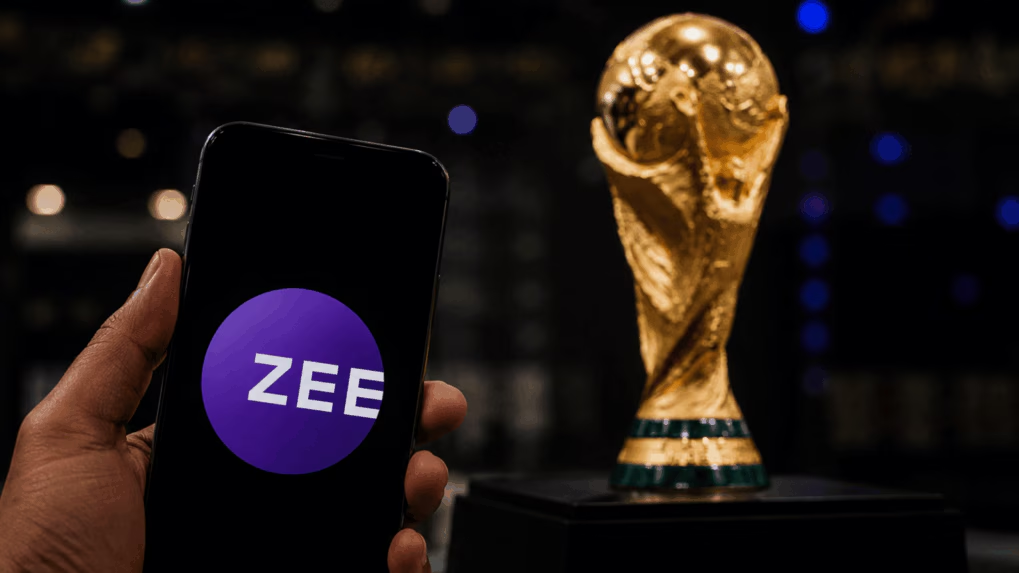
Zee Entertainment Enterprises’ decision to return to sports broadcasting with the FIFA World Cup 2026 has delivered a massive audience, but the company is paying a significant near-term profitability price for the gamble.
The broadcaster’s FIFA coverage reached around 400 million Indians, giving Zee a major opportunity to expand its sports and digital footprint. At the same time, Zee’s consolidated revenue increased 4.8% year on year to ₹1,938.5 crore in the June 2026 quarter. However, profit declined sharply as the company absorbed higher programming, promotional and sports-launch costs.
The result captures the central question around Zee’s FIFA strategy: Can a huge audience eventually translate into enough advertising, subscriptions and digital growth to justify the cost of the rights?
FIFA reaches nearly 400 million Indians
The biggest immediate success from Zee’s sports strategy has been audience reach.
Zee’s FIFA World Cup 2026 coverage reached roughly 400 million viewers in India, giving the company one of its largest opportunities to attract audiences beyond its traditional entertainment programming.
The tournament also helped ZEE5 expand its reach. Brokerage CLSA said weekly active users on the streaming platform doubled after the World Cup began, highlighting the potential of live sports to drive digital engagement.
             ZEE'S FIFA REACH

              FIFA 2026
                  │
                  ↓
        ~400 MILLION INDIANS
                  │
       ┌──────────┴──────────┐
       ↓                     ↓
     TV                     ZEE5
       │                     │
       ↓                     ↓
 Traditional             Digital
 audience                audience
The scale is important because Zee has historically been much more closely associated with general entertainment, regional programming and television channels than with premium sports.
Revenue rises 4.8% to ₹1,938.5 crore
Zee’s consolidated total income increased 4.8% year on year to ₹1,938.5 crore in the first quarter of FY27.
| Metric | Q1 FY27 | YoY change |
|---|---|---|
| Total income | ₹1,938.5 crore | +4.8% |
| Net profit | ₹76.3 crore | -46.9% |
| Advertising revenue | ₹671 crore | -11.5% |
| Subscription revenue | ₹1,137 crore | +15.8% |
| Total expenses | ₹1,864 crore | +12.8% |
| Advertising & publicity expense | ₹447 crore | +62.4% |
The numbers show a business caught between two forces: subscription and digital growth on one side, and weak advertising plus heavy sports investment on the other.
Profit falls nearly 47%
The advertising backdrop is difficult across media — X ad revenue fell to $367 million, down 66% from Twitter’s Q2 2022, while YouTube raised its monetisation requirements.
While revenue grew, Zee’s bottom line moved in the opposite direction.
Net profit fell 46.9% to ₹76.3 crore, compared with ₹143.7 crore in the year-earlier quarter.
ZEE NET PROFIT

Q1 FY26
₹143.7 crore
████████████████████████████

Q1 FY27
₹76.3 crore
██████████████

Decline: 46.9%
The decline illustrates the difficult economics of entering premium sports broadcasting.
Buying or securing major sports rights can create huge audience reach, but broadcasters have to spend heavily on production, promotion, channel launches and marketing before the advertising and subscription benefits fully materialise.
Advertising revenue falls despite the World Cup
Advertising remains one of Zee’s most important revenue streams, accounting for roughly 35% of total income.
But advertising revenue declined 11.5% to ₹671 crore during the quarter.
ADVERTISING

Q1 FY26
~₹758 crore
████████████████████████

Q1 FY27
₹671 crore
██████████████████████

YoY: -11.5%
Zee said the advertising environment was affected by weak demand, while the Middle East crisis also hurt advertising activity during the quarter.
The FIFA tournament helped advertising recover in June, but the benefit was not enough to offset weakness across the broader quarter.
Subscription revenue provides a bright spot
Subscription revenue performed considerably better.
It increased 15.8% to ₹1,137 crore, helped by higher pricing and growth in digital subscribers.
SUBSCRIPTION REVENUE

Q1 FY26
~₹982 crore
██████████████████████

Q1 FY27
₹1,137 crore
█████████████████████████

Growth: +15.8%
This is particularly important for ZEE5.
Unlike traditional television advertising, subscriptions can create recurring revenue and allow Zee to monetise audiences directly.
The FIFA rights therefore have a potential role beyond advertising: they can act as a customer-acquisition tool for ZEE5.
The FIFA gamble is really a ZEE5 gamble
The most important strategic question may not be how much money Zee makes from advertising during the 2026 World Cup.
It may be how many new users remain on ZEE5 after the tournament ends.
FIFA WORLD CUP
      ↓
Massive audience
      ↓
ZEE5 downloads
      ↓
New users
      ↓
Subscriptions
      ↓
Other content consumption
      ↓
Long-term customer value
If millions of football viewers continue using ZEE5 for entertainment, movies, series and future sports events, the FIFA investment could produce benefits for years.
If users disappear once the World Cup ends, the economics become much less attractive.
Zee bought more than one World Cup
One of the key features of the deal is that Zee did not acquire rights only for the 2026 tournament.
The agreement covers 39 FIFA events through 2034, including the 2026 and 2030 men’s World Cups and the 2027 Women’s World Cup.
ZEE + FIFA
2026 ── Men's World Cup
2027 ── Women's World Cup
       ├─ Youth competitions
       ├─ Futsal events
       ├─ Other FIFA tournaments
2030 ── Men's World Cup
       │
       ↓
2034 ── End of rights package
That changes the investment calculation.
Zee can potentially build a long-term football audience instead of starting from scratch every four years.
Why the 2034 horizon matters
A single World Cup creates a huge but temporary audience spike.
A multi-event agreement provides a much longer content pipeline.
ONE-OFF RIGHTS

World Cup
   ↓
Audience spike
   ↓
Tournament ends
   ↓
Audience declines


ZEE'S FIFA PACKAGE

2026
 ↓
2027
 ↓
2028+
 ↓
2030
 ↓
2031+
 ↓
2034
The strategy is to turn FIFA into a recurring content franchise for Zee.
That could potentially help ZEE5 reduce its dependence on entertainment content alone.
Zee is challenging India’s sports broadcasting hierarchy
Indian sports broadcasting has traditionally been dominated by major players with strong cricket portfolios.
Zee’s FIFA move represents an attempt to create a separate position around global football.
The company secured the rights at a time when other major broadcasters were reluctant to pay FIFA’s original asking price. Reuters reported that FIFA had initially sought around $100 million for the India package covering the 2026 and 2030 men’s World Cups before reducing its asking price.
INDIAN SPORTS MEDIA

Cricket
   ↓
Dominant audience
   ↓
Large rights values

ZEE'S STRATEGY

Football
   ↓
FIFA
   ↓
Underserved premium sports audience
   ↓
ZEE5 differentiation
This gives Zee a way to compete without directly trying to replicate the enormous cricket rights portfolios of rivals.
Why FIFA makes sense for ZEE5
Football has several characteristics that make it attractive to a streaming platform.
It has:
- A young audience
- Strong international appeal
- Highly engaged fans
- Social-media activity
- Global stars and clubs
- Potential for live and short-form content
FOOTBALL FAN

Live match
   +
Highlights
   +
Analysis
   +
Interviews
   +
Short videos
   +
Social content
        ↓
YEAR-ROUND ENGAGEMENT
That can help ZEE5 build a stronger relationship with younger digital consumers.
But India’s football audience is not cricket’s audience
This is where the gamble becomes more complicated.
Football has a large and passionate following in India, but cricket remains far more commercially dominant.
That means Zee cannot assume that FIFA’s enormous reach will automatically translate into cricket-like advertising rates or subscription numbers.
CRICKET
★★★★★
Mass-market reach

FOOTBALL
★★★–★★★★
Large, passionate audience

COMMERCIAL QUESTION:
Can football monetisation catch up
with audience scale?
The answer will depend heavily on advertiser demand and the ability of ZEE5 to retain users.
FIFA helped Zee attract digital audiences
The World Cup appears to have delivered a meaningful boost to ZEE5.
CLSA said weekly active users doubled after the tournament started.
This is strategically important because digital engagement is one of the biggest battlegrounds in India’s media industry.
BEFORE FIFA
ZEE5
│
├── Entertainment
├── Movies
└── Regional content

AFTER FIFA
ZEE5
│
├── Entertainment
├── Movies
├── Regional content
└── LIVE SPORTS
       ↓
New audience
The challenge now is retaining those users.
Sports rights are expensive to launch
Zee’s total expenses increased 12.8% to ₹1,864 crore in the quarter.
The increase was partly linked to its return to sports broadcasting.
Advertising and publicity expenses jumped 62.4% to ₹447 crore, reflecting the promotional push around FIFA and the launch of sports channels.
FIFA INVESTMENT

Rights
 +
Production
 +
Marketing
 +
Promotion
 +
New sports channels
 +
Distribution
      ↓
Higher costs
      ↓
Short-term margin pressure
This is why the audience numbers alone cannot determine whether the strategy is successful.
Zee needs the audience to eventually produce sustainable cash flows.
The new sports channels add another cost layer
Zee launched dedicated sports channels as part of its FIFA strategy.
That allows the company to monetise the rights through traditional television as well as digital streaming.
FIFA RIGHTS
     │
 ┌───┴────┐
 ↓        ↓
TV       ZEE5
 ↓        ↓
Ads    Subscriptions
 ↓        ↓
Revenue + Revenue
The dual-platform approach increases monetisation opportunities but also requires greater investment in distribution, programming and promotion.
The timing of the World Cup created a major challenge
The 2026 World Cup was played in the United States, Canada and Mexico.
That meant many matches were scheduled at inconvenient hours for Indian viewers.
Reuters noted that the time-zone difference was one reason broadcasters were reluctant to pursue the rights aggressively.
NORTH AMERICA
       ↓
Match timings
       ↓
Late night / early morning
       ↓
India
       ↓
Potentially lower live-TV advertising value
This was a major risk built into Zee’s FIFA investment.
Yet the audience proved strong
Despite the difficult timing, the tournament reached around 400 million Indians according to Zee’s reported audience figures.
That suggests football’s Indian fan base is sufficiently engaged to watch even when matches are not scheduled during prime evening hours.
The question now is whether that level of attention can be repeated for future FIFA events.
Zee needs advertisers to follow the audience
A major challenge for sports broadcasters is converting viewership into advertising revenue.
A huge audience is valuable only if advertisers are willing to pay attractive rates to reach it.
HIGH VIEWERSHIP
      ↓
Advertiser interest
      ↓
Higher ad rates
      ↓
Higher revenue
      ↓
Rights economics improve
So far, Zee’s Q1 numbers show that the advertising market remains difficult.
Advertising revenue fell 11.5% despite the FIFA opportunity.
The company will need stronger monetisation in subsequent quarters.
June offered an early sign of improvement
Zee said FIFA helped drive a recovery in advertising revenue in June.
This is potentially important because the World Cup began in June, meaning the first quarter captured only part of the tournament.
APRIL
Weak advertising
      ↓
MAY
Pressure continues
      ↓
JUNE
FIFA begins
      ↓
Advertising recovery
The next quarters will provide a clearer picture of how much incremental advertising value the tournament actually created.
The cost-revenue gap is the key issue
Zee’s current numbers can be simplified into one chart:
Q1 FY27

Revenue
₹1,938.5 crore
████████████████████████████████████

Expenses
₹1,864 crore
███████████████████████████████████

Profit
₹76.3 crore
█
The company remains profitable, but the margin is thin relative to the scale of its operations.
That makes sustained cost growth a concern.
The FIFA investment could work over several years
The rights should not necessarily be judged solely by the first quarter.
Zee has rights through 2034, giving it multiple opportunities to build an audience.
2026
Audience acquisition
      ↓
2027
Women's World Cup
      ↓
More engagement
      ↓
2028–29
Other FIFA events
      ↓
Audience retention
      ↓
2030
Men's World Cup
      ↓
Major monetisation opportunity
If ZEE5 becomes a recognised destination for football in India, the value of the rights could increase over time.
Zee is trying to build a football ecosystem
The long-term strategy is bigger than simply showing matches.
Zee can potentially develop:
- Live matches
- Pre-match shows
- Post-match analysis
- Football documentaries
- Player interviews
- Short-form clips
- Fantasy and engagement features
- Regional-language content
- Advertising packages
FIFA RIGHTS
     ↓
CONTENT ECOSYSTEM
     ├── LIVE
     ├── ANALYSIS
     ├── SHORT VIDEO
     ├── DOCUMENTARIES
     ├── SOCIAL
     └── REGIONAL CONTENT
This increases the number of ways Zee can monetise each FIFA property.
The biggest opportunity is younger viewers
Traditional television networks face a long-term challenge as younger audiences shift toward digital platforms.
Sports can help accelerate that transition.
YOUNGER VIEWER
      ↓
Mobile
      ↓
ZEE5
      ↓
Live football
      ↓
Account created
      ↓
Other ZEE5 content
If this conversion works, FIFA can become a customer-acquisition engine rather than simply a sports-rights expense.
But user retention is the real test
The World Cup creates a natural temporary spike.
The real question is what happens after the final.
WORLD CUP
   ↓
Huge traffic
   ↓
New users
   ↓
Tournament ends
   ↓
?????????
   ↓
Do users stay?
If users continue watching ZEE5’s entertainment and sports content, the economics improve.
If they cancel subscriptions after the tournament, the acquisition cost becomes much harder to justify.
Zee’s Q1 performance at a glance
┌─────────────────────────────────────┐
│          ZEE Q1 FY27                │
├─────────────────────────────────────┤
│ Revenue             ₹1,938.5 crore  │
│ Revenue growth             +4.8%    │
│ Net profit             ₹76.3 crore  │
│ Profit growth            -46.9%     │
│ Ad revenue             ₹671 crore   │
│ Ad growth                 -11.5%    │
│ Subscription revenue ₹1,137 crore  │
│ Subscription growth       +15.8%    │
│ Total expenses       ₹1,864 crore   │
│ Expense growth           +12.8%     │
│ FIFA events               39        │
│ FIFA rights through      2034       │
│ FIFA reach             ~400M        │
│ ZEE5 weekly users       ~2x         │
└─────────────────────────────────────┘
The business case for Zee’s FIFA gamble
| Opportunity | Potential benefit |
|---|---|
| ~400M audience reach | Massive brand visibility |
| FIFA 2026 | Subscriber acquisition |
| 39 events through 2034 | Long-term content pipeline |
| ZEE5 growth | Digital audience expansion |
| Football’s younger audience | Demographic diversification |
| TV + OTT distribution | Multiple monetisation channels |
| Women’s and youth FIFA events | Year-round engagement |
| Global football content | Differentiation from cricket-heavy rivals |
The risks behind the strategy
| Risk | Why it matters |
|---|---|
| High sports costs | Can pressure margins |
| Weak advertising market | Limits monetisation |
| Difficult match timings | Can reduce live-TV value |
| User churn after World Cup | Weakens ZEE5 economics |
| Competition | Other OTT platforms have larger sports ecosystems |
| Football vs cricket | Football monetisation remains less proven |
| Production and promotion costs | Increase upfront investment |
| Long rights commitment | Requires sustained execution through 2034 |
What Zee needs to prove next
1. Convert viewers into subscribers
The 400-million reach is impressive, but Zee needs a meaningful percentage of those viewers to become paying or regularly active ZEE5 users.
2. Retain FIFA audiences
The most important data will be ZEE5 engagement after the World Cup.
3. Improve advertising monetisation
The company needs FIFA viewership to translate into stronger ad pricing and revenue.
4. Control sports costs
If promotional and programming costs continue rising faster than revenue, the sports strategy could remain a drag on profitability.
5. Build a year-round football audience
The value of the 39-event package depends on Zee keeping fans engaged between major World Cups.
Why this matters for India’s media industry
Zee’s FIFA strategy reflects a broader shift in Indian media.
Sports rights are no longer simply television assets.
They are becoming customer-acquisition tools for streaming platforms.
OLD MEDIA MODEL

Content
 ↓
TV viewers
 ↓
Advertising


NEW MEDIA MODEL

Premium sports
 ↓
TV + OTT
 ↓
Audience acquisition
 ↓
Subscriptions
 ↓
Engagement
 ↓
Advertising
 ↓
Data
 ↓
Long-term customer value
This is why the success or failure of Zee’s FIFA investment will matter beyond football.
It could provide a useful case study for how Indian broadcasters should approach expensive international sports rights in an increasingly digital market.
Conclusion
Zee Entertainment’s FIFA gamble has delivered one thing almost immediately: scale.
The company’s 2026 World Cup coverage reached roughly 400 million Indians, while ZEE5’s weekly active users reportedly doubled after the tournament began. That gives Zee a major opportunity to build a new audience around football and strengthen its digital platform.
But scale has not yet translated into an equivalent improvement in profitability.
Zee’s total income rose 4.8% to ₹1,938.5 crore in Q1 FY27, while net profit fell 46.9% to ₹76.3 crore. Advertising revenue declined 11.5% to ₹671 crore, although subscription revenue provided a positive counterpoint by rising 15.8% to ₹1,137 crore.
The biggest reason for the pressure is cost.
Zee’s total expenses rose 12.8% to ₹1,864 crore, while advertising and publicity spending jumped 62.4% to ₹447 crore as the company promoted FIFA coverage and launched its sports channels.
That makes the FIFA investment a classic audience-first strategy.
Zee is effectively spending heavily today in the hope of building a valuable sports and streaming franchise for tomorrow.
The long-term rights package strengthens that argument. The company has secured 39 FIFA events through 2034, including the 2026 and 2030 men’s World Cups and the 2027 Women’s World Cup.
That means Zee has several years to turn football into a recurring content ecosystem rather than relying on one tournament.
The biggest opportunity lies with ZEE5.
If viewers who discovered the platform through FIFA continue watching movies, series, regional content and future sports events, the value of the World Cup rights could extend far beyond advertising during individual matches.
But if most of those viewers disappear after the tournament, Zee will have a much harder time recovering its investment.
The first-quarter results therefore offer a mixed picture.
Audience: strong.
Digital engagement: promising.
Subscription growth: strong.
Advertising: weak.
Costs: rising rapidly.
Profitability: under pressure.
The next phase of Zee’s FIFA strategy will be about converting the 400-million audience headline into recurring revenue.
That is the real test of whether the company’s return to sports broadcasting is a bold strategic move—or an expensive gamble.
For now, Zee has proved that Indians will watch FIFA.
The harder question is whether they will keep watching ZEE5, keep paying for it and keep attracting advertisers long after the World Cup is over.
Frequently Asked Questions
How many people did Zee’s FIFA coverage reach?
The FIFA World Cup 2026 coverage reached nearly 400 million Indians.
What happened to Zee’s Q1 numbers?
Revenue rose 4.8% to ₹1,938.5 crore, but profit fell nearly 47% as the cost of the sports rights hit near-term profitability.
Why is the FIFA deal described as a ZEE5 gamble?
The sports rights are meant to drive viewers to the ZEE5 streaming platform, and Zee bought more than one World Cup, so the payoff is expected to build over multiple tournaments rather than a single quarter.
Get the day’s top stories in your inbox
One concise email. No spam, unsubscribe anytime.


