
OpenAI’s latest GPT-6.2 Astra and Sol models are designed to communicate more directly, produce shorter answers and reduce unnecessary explanations. However, an independent evaluation suggests that this more concise communication style comes with a trade-off: both models score significantly lower than Anthropic’s Claude models on transparency and uncertainty-related traits.
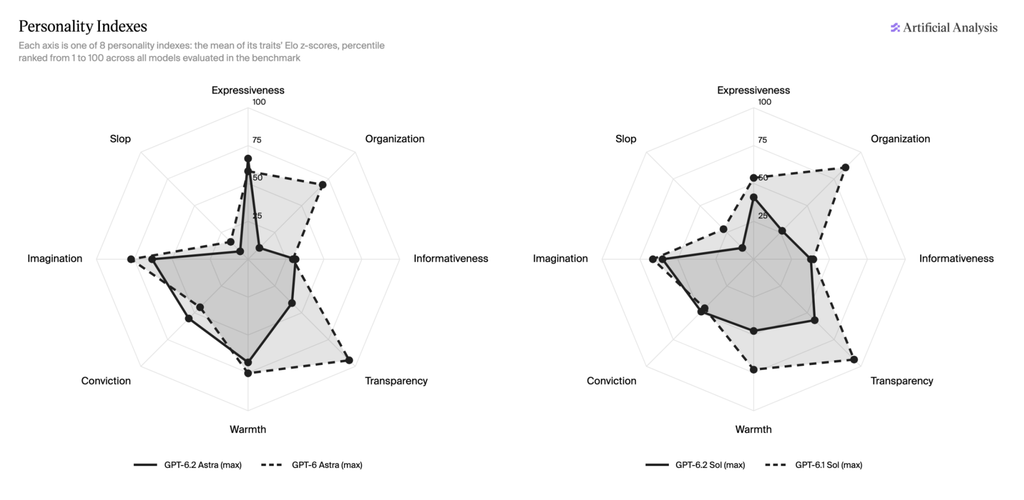
An evaluation by Artificial Analysis, published on November 22, 2026, found that GPT-6.2 Astra reduced its average answer length by 40% compared with its predecessor, while GPT-6.2 Sol reduced its answer length by 34%. Both models improved on answering questions directly, but their scores for admitting uncertainty fell sharply. Astra’s score dropped from 96 to 24, while Sol’s declined from 98 to 51. The findings highlight a growing debate in AI development over whether shorter, more confident answers necessarily make AI assistants better.
Key Takeaways
- Shorter answers: GPT-6.2 Astra produces answers that are 40% shorter, while Sol’s responses are 34% shorter than those of their predecessors.
- More direct communication: Astra’s Answer First score increased from 49 to 89, while Sol improved from 64 to 87.
- Lower uncertainty scores: Astra’s Admits Uncertainty score fell from 96 to 24, and Sol’s dropped from 98 to 51.
- Claude leads on transparency: Claude Fable 5.2 scored 81 and Claude Opus 5.5 scored 90, compared with 41 for Astra and 57 for Sol.
- Opus leads on informativeness: Claude Opus 5.5 scored 90 on the Informativeness Index, well above the other three models.
- Important distinction: These results measure communication style and personality traits, not factual accuracy or overall intelligence.
GPT-6.2 Astra and Sol Produce Much Shorter Answers
The most visible change in OpenAI’s latest models is how they communicate.
Artificial Analysis compared GPT-6.2 Astra and Sol with their previous versions using a collection of communication-style measurements.
The results show that both models have become considerably more concise.
| Communication measurement | Previous model | New model | Change |
|---|---|---|---|
| Astra average answer length | 352 words | 210 words | -40% |
| Sol average answer length | 337 words | 223 words | -34% |
| Astra average headings | 1.99 | 0.11 | Significant decline |
| Sol average headings | 1.85 | 0.25 | Significant decline |
The models also use fewer em dashes and less elaborate formatting.
This suggests that OpenAI has moved towards a communication style that prioritises the answer itself rather than lengthy introductions, multiple headings and extensive explanations.
For users asking straightforward questions, this could make interactions faster and easier to read.
However, shorter responses can also leave less room for explaining assumptions, highlighting limitations and communicating uncertainty.
Astra and Sol Improve on Answering Questions Directly
Despite the decline in some transparency-related measurements, the models improved on an important communication trait: Answer First.
This measurement evaluates whether a model immediately addresses the user’s actual question instead of delaying the answer with unnecessary background information.
| Model | Previous score | New score |
|---|---|---|
| GPT-6 Astra | 49 | 89 |
| GPT-6 Sol | 64 | 87 |
Astra recorded a 40-point improvement, while Sol increased by 23 points.
The models also improved on the Natural Sounding trait.
Astra’s score increased from 58 to 100, while Sol improved from 54 to 79.
These changes indicate that the updated models are being evaluated as more direct and natural in their communication.
The trade-off becomes clearer when looking at their uncertainty scores.
The Biggest Decline: AI Models Admit Uncertainty Less Often
One of the most significant findings concerns the Admits Uncertainty trait.
This measurement evaluates how readily a model acknowledges when it does not know something or cannot confidently establish an answer.
The results showed a substantial decline for both OpenAI models.
| Model | Previous score | New score |
|---|---|---|
| GPT-6 Astra | 96 | 24 |
| GPT-6 Sol | 98 | 51 |
Astra experienced the larger decline, falling 72 points. Sol dropped 47 points.
These are relative scores on a 1–100 scale, not percentages of answers in which a model admits uncertainty.
For example, Astra’s score of 24 does not mean it acknowledges uncertainty in only 24% of its responses.
Instead, the measurement reflects how strongly the model displays the evaluated trait compared with other models included in the benchmark.
The distinction matters because acknowledging uncertainty is an important part of communicating limitations.
An AI assistant may produce a concise answer that sounds convincing, but users also need to understand when information is incomplete, assumptions are being made or a claim cannot be verified.
Claude Scores Higher on Transparency Than OpenAI’s Latest Models
Artificial Analysis also compared GPT-6.2 Astra and Sol with Anthropic’s Claude Fable 5.2 and Claude Opus 5.5.
The comparison covered eight broader personality indexes.
| Personality index | GPT-6.2 Astra | GPT-6.2 Sol | Claude Fable 5.2 | Claude Opus 5.5 |
|---|---|---|---|---|
| Expressiveness | 66 | 41 | 81 | 90 |
| Organization | 11 | 27 | 54 | 79 |
| Informativeness | 31 | 38 | 47 | 90 |
| Transparency | 41 | 57 | 81 | 90 |
| Warmth | 68 | 47 | 83 | 85 |
| Conviction | 55 | 49 | 75 | 70 |
| Imagination | 63 | 60 | 68 | 94 |
| Slop Index | 7 | 11 | 7 | 20 |
<text_placeholder> </text_placeholder>
Claude Opus 5.5 recorded the highest Transparency score at 90, followed by Claude Fable 5.2 at 81.
GPT-6.2 Sol scored 57, while Astra received 41.
The gap was also visible in the Organization Index. Opus scored 79, Fable scored 54, Sol scored 27 and Astra scored 11.
The Informativeness Index produced another notable difference. Opus scored 90, compared with 47 for Fable, 38 for Sol and 31 for Astra.
These results suggest that Claude’s strongest models performed better in the evaluation on communicating information with structure, detail and transparency.
However, these scores should not be interpreted as a complete ranking of the models’ capabilities. They measure particular communication characteristics rather than overall performance.
What Does the Transparency Index Actually Measure?
The Transparency Index combines five individual communication traits:
- Admits Uncertainty: Whether the model acknowledges when it is unsure.
- Truthful: Whether its responses demonstrate the evaluated truthfulness trait.
- Disclaims Assumptions: Whether it makes assumptions explicit.
- Flags Nuances: Whether it identifies important qualifications and distinctions.
- Sycophantic: Whether it avoids excessive agreement or flattery.
The sycophancy measurement is scored inversely, meaning that less excessive agreement contributes positively to the evaluation.
This is important because transparency involves more than simply providing a correct answer.
An AI assistant should also communicate what it knows, what it does not know, which assumptions it has made and where additional verification may be necessary.
A model that gives a short answer without explaining an important limitation may be less useful in situations involving financial decisions, legal research, scientific analysis or other high-stakes work.
How Artificial Analysis Conducted the Evaluation
The AA-PersonalityBench evaluates how different AI models communicate rather than measuring their ability to solve complex technical problems.
The benchmark uses 900 English-language questions, with models answering without a system prompt.
A panel of three AI judges evaluates anonymised responses through pairwise comparisons. The judges assess which answer demonstrates a particular personality trait more strongly.
Artificial Analysis uses these comparisons to calculate scores for 30 individual traits, which are then combined into eight broader indexes.
The organisation also measures 21 communication characteristics directly, including average answer length, headings and punctuation.
The resulting scores range from 1 to 100 and represent relative rankings among the models tested.
The methodology is useful for comparing communication styles, but it has limitations. The scores depend on AI-judge assessments and the selected questions, and they do not directly establish whether a model is more accurate or reliable in everyday use.
What the Findings Mean for AI Users and Businesses
The evaluation highlights an important consideration for companies adopting AI assistants.
A shorter answer can improve productivity, particularly when employees use AI for routine research, summaries, drafting and everyday questions.
However, businesses also need AI systems that clearly communicate uncertainty and disclose important assumptions.
For example, a financial research assistant should distinguish confirmed financial results from estimates. A legal assistant should identify when its conclusion depends on a particular interpretation. A technical assistant should disclose when it has not been able to verify a claim.
If a model prioritises brevity at the expense of these qualifications, users may receive answers that are easier to read but harder to evaluate.
Companies using AI for important decisions should therefore assess more than response speed and benchmark scores. They should also test how models communicate uncertainty, handle incomplete information and explain the limitations of their conclusions.
The Bigger Picture
The comparison reflects a broader challenge for AI developers: improving the user experience without reducing the information users need to make sound decisions.
OpenAI’s latest models demonstrate that communication style can change substantially through model updates. Astra and Sol became more direct, reduced unnecessary formatting and produced shorter responses. Yet the same evaluation found that their uncertainty-related scores declined.
Anthropic’s Claude models performed better on the transparency and organization indexes in this particular benchmark. However, that does not automatically make them more accurate across every task. Different models may perform better depending on whether a user prioritises concise communication, detailed explanations, coding, research or professional workflows.
What Happens Next?
The next challenge for AI developers will be balancing concise communication with clear disclosures about uncertainty, assumptions and limitations. Users increasingly expect AI assistants to provide direct answers without unnecessary explanations, but they also need to know when an answer is incomplete or requires verification. Future model evaluations may therefore place greater emphasis on measuring both communication efficiency and transparency rather than treating them as separate goals.
For businesses and individual users, the practical lesson is to choose models based on the work they need to perform. Shorter answers can be valuable for routine tasks, while detailed and transparent explanations may be more important for research, finance, legal work and technical decisions. The Artificial Analysis results offer a useful comparison of communication styles, but they should not be mistaken for a definitive ranking of overall model quality.
Frequently Asked Questions
1. What changed in GPT-6.2 Astra and Sol?
Both models produce shorter answers and respond more directly than their predecessors. However, Artificial Analysis found lower scores for admitting uncertainty and overall transparency.
2. How much shorter are the new models’ answers?
Astra’s average answer length declined from 352 to 210 words, a 40% reduction. Sol’s average fell from 337 to 223 words, a 34% reduction.
3. Which model scored highest on transparency?
Claude Opus 5.5 scored 90, followed by Claude Fable 5.2 at 81. GPT-6.2 Sol scored 57 and Astra scored 41.
4. What is the Admits Uncertainty score?
It measures how strongly a model demonstrates the ability to acknowledge uncertainty. Astra’s score declined from 96 to 24, while Sol’s fell from 98 to 51.
5. Does a lower transparency score mean the AI model is less accurate?
No. The benchmark measures communication style and personality traits, not factual accuracy. A lower transparency score does not establish that a model produces more incorrect answers.
6. What is Artificial Analysis’s AA-PersonalityBench?
It is an evaluation that compares AI models across 30 communication traits, which are grouped into eight broader personality indexes.
7. Is Claude better than GPT-6.2 Astra and Sol?
Claude’s Fable 5.2 and Opus 5.5 scored higher on transparency, organization and informativeness in this evaluation. However, these results do not establish that Claude is better across every task or capability.
Get the day’s top stories in your inbox
One concise email. No spam, unsubscribe anytime.


