
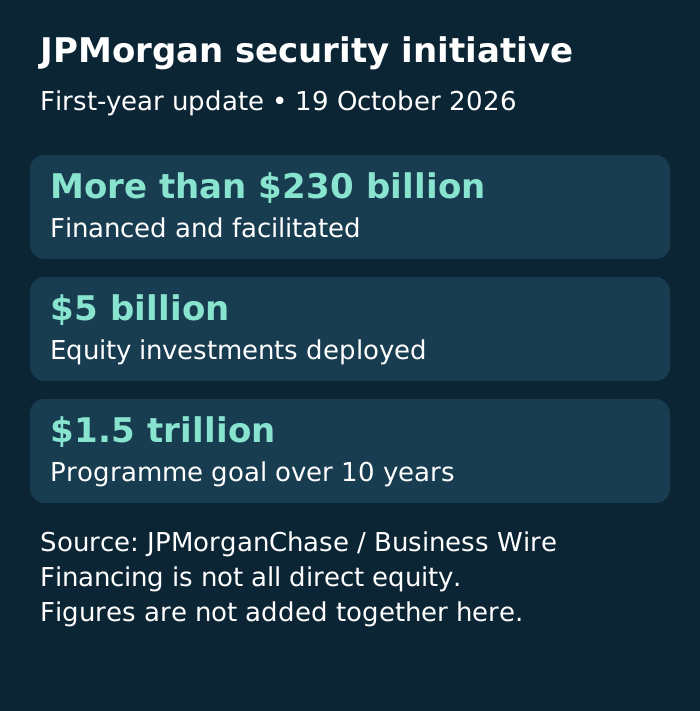
JPMorgan Chase has financed and facilitated more than $230 billion in its first year of the Security and Resiliency Initiative, a decade-long programme designed to support industries considered critical to US economic and national security. Launched in 2025, the initiative aims to facilitate $1.5 trillion in investment over 10 years, with a focus on domestic manufacturing, energy independence, defence and aerospace, advanced technologies and supply chain resilience. The bank announced the first-year milestone on October 19, 2026, alongside an update on its direct investments in strategic companies.
The $230 billion figure does not represent money invested directly by JPMorgan from its own balance sheet. Instead, it includes financing and capital-market activity that the bank has provided or facilitated for businesses across targeted industries. Separately, JPMorgan has deployed $5 billion of its own capital in equity investments, reaching half of its initial $10 billion allocation for the programme. The initiative reflects a broader effort by financial institutions to finance infrastructure, industrial capacity and technology businesses as companies and governments reassess vulnerabilities in global supply chains.
Key Takeaways
- First-year milestone: JPMorgan has financed and facilitated more than $230 billion under its Security and Resiliency Initiative.
- Long-term target: The programme aims to support $1.5 trillion in investment over 10 years.
- Direct equity investments: JPMorgan has committed $5 billion of its own capital, half of its initial $10 billion allocation.
- Target sectors: Advanced manufacturing, defence and aerospace, energy, strategic technologies, pharmaceuticals and health technology.
- Examples: Supported transactions include a Korea Zinc smelter in Tennessee, Fervo Energy’s public offering and financing for a renewable-energy acquisition by Drax.
- Commercial approach: JPMorgan says the initiative is a commercial investment and financing effort, not a charitable funding programme.
- Broader context: The initiative seeks to strengthen industrial capacity and reduce vulnerabilities in critical supply chains.
What Is JPMorgan’s Security and Resiliency Initiative?
JPMorgan Chase launched the Security and Resiliency Initiative to help finance businesses and projects that support the long-term resilience of the US economy. The programme combines lending, equity investment, financial advice, capital-market services and engagement with businesses and policymakers.
The bank argues that economic security depends partly on having reliable access to essential materials, energy, technology and manufacturing capacity. Disruptions to international supply chains can affect industries ranging from electronics and pharmaceuticals to defence equipment and infrastructure.
The initiative is intended to help businesses expand production, modernise facilities and develop technologies that may be important to the country’s long-term industrial capacity.
JPMorgan has established dedicated teams to identify projects and companies that fit the programme’s objectives. More than 35 bankers have been assigned to the effort, according to reporting on the first-year milestone.
The initiative has also expanded its geographic scope to include Canada and Europe, reflecting the cross-border nature of many industrial supply chains. Although its original emphasis is on strengthening US economic resilience, many projects depend on suppliers, investors and customers operating internationally.
Why JPMorgan launched the programme
JPMorgan Chief Executive Jamie Dimon has repeatedly warned about geopolitical risks and excessive dependence on unreliable sources of critical products and materials. The initiative builds on that concern by using the bank’s financing capabilities to support selected industries.
The programme’s stated priorities include strengthening domestic production, improving access to energy and strategic materials, and supporting companies developing technologies relevant to industrial and national security.
These priorities have economic as well as strategic dimensions. Manufacturing facilities, energy projects and technology businesses require substantial capital, and many need financing years before they generate returns.
By providing debt financing, helping companies raise equity and investing directly in selected businesses, JPMorgan aims to support projects that might otherwise face funding, execution or expansion challenges.
However, the programme does not mean every project in a targeted industry will receive funding. Each transaction remains subject to commercial assessment, credit considerations, investment criteria and the bank’s usual approval processes.
Breaking Down the $230 Billion Milestone
The distinction between financing facilitated and capital invested directly is essential to understanding the initiative.
JPMorgan has reported more than $230 billion in financing and capital-market activity during the first year. This can include arranging debt, underwriting securities, advising on transactions and providing other financial services that help companies raise or deploy capital.
Separately, the bank has allocated $5 billion of its own capital to direct equity investments through its Strategic Investment Group.
| Initiative metric | Reported figure |
|---|---|
| Long-term investment target | $1.5 trillion over 10 years |
| Financing and investment facilitated in year one | More than $230 billion |
| Direct equity capital deployed | $5 billion |
| Initial direct-equity allocation | $10 billion |
| Share of initial direct-equity allocation deployed | 50% |
| Dedicated banking team | More than 35 bankers |
Source: JPMorgan Chase’s October 19, 2026, announcement and reporting on the initiative.
The two figures measure different activities and should not be added together as if they represent entirely separate pools of funding. Direct investments may form part of the broader programme, while financing facilitated can cover a range of transactions involving third-party capital.
The $230 billion milestone represents approximately 15.3% of the $1.5 trillion long-term target. That comparison offers a rough sense of scale, but it does not mean the bank must deploy exactly the same amount every year. Financing demand, transaction timing and the size of individual projects can vary substantially.
JPMorgan has also indicated that the ultimate amount could exceed its initial commitment, depending on opportunities and demand.
Which Industries Are Receiving Support?
The initiative focuses on five broad areas: supply chain and advanced manufacturing, defence and aerospace, energy independence and resilience, frontier and strategic technologies, and pharmaceuticals and health technology.
These sectors have different capital requirements and business cycles. A manufacturing plant may require years of construction and equipment investment, while a technology company may need capital to develop products, expand production or commercialise research.
Advanced manufacturing and critical materials
Manufacturing capacity is a central part of the initiative because industrial supply chains often depend on specialised materials and a relatively small number of producers.
JPMorgan cited Korea Zinc’s planned $7.4 billion smelter in Tennessee as one example of activity supported by the programme. Projects involving metal processing and critical materials can help diversify supply sources and provide inputs needed by electronics, energy and other industrial businesses.
Such facilities can also create demand for construction, engineering, transport and skilled labour. However, their long-term impact depends on whether projects are completed on schedule, achieve competitive production costs and attract sufficient demand.
Energy infrastructure and independence
Reliable energy is essential for manufacturing, data centres, transport and industrial operations. The initiative therefore includes energy infrastructure, power generation and technologies intended to improve energy resilience.
JPMorgan supported geothermal energy developer Fervo Energy’s initial public offering, according to the reported examples. Geothermal projects use heat from underground resources to generate electricity and can potentially provide power with less dependence on weather conditions than some renewable sources.
The commercial viability of these projects depends on construction costs, technology performance, electricity demand, regulatory conditions and access to financing.
Energy investments can take years to develop, making access to long-term capital important. Their benefits also extend beyond electricity generation, as dependable power can help support manufacturing expansion and the growth of energy-intensive technologies.
Defence and aerospace
Defence and aerospace are another focus area. The sector requires specialised manufacturing, advanced materials, electronics, propulsion systems and complex supply chains.
Investment can support companies developing new equipment and technologies, as well as suppliers expanding production capacity. The initiative also identifies next-generation defence technologies as an area for direct equity investment.
However, funding a company does not guarantee that its products will be adopted by governments or that its investments will produce commercial returns. Procurement processes, regulation, technology performance and government spending priorities all affect outcomes.
Strategic technology and healthcare
JPMorgan’s focus on frontier technologies includes businesses working on technologies with potential industrial or security applications. The initiative also covers pharmaceuticals and health technology, sectors where supply continuity and domestic production can be strategically important.
Pharmaceutical manufacturing, medical equipment and critical healthcare inputs can be vulnerable to disruptions when production is concentrated in a limited number of locations. Financing may help companies expand capacity, modernise facilities and diversify their suppliers.
Across these areas, the programme’s stated objective is to combine financial capital with expertise and relationships that can help businesses scale.
JPMorgan’s $5 Billion Direct Investment Programme
Alongside its financing activity, JPMorgan has deployed $5 billion of its own capital in equity investments through its Strategic Investment Group. That represents half of the initial $10 billion allocation for direct investments under the initiative.
The group is led by Todd Combs, who joined JPMorgan after previously serving as an investment manager at Berkshire Hathaway. Its role is to identify companies with long-term strategic importance and invest in businesses that could strengthen critical industries.
Unlike a loan, an equity investment gives the bank an ownership interest in a company. The value of that investment can rise if the business grows and becomes more valuable, but it can also fall if the company underperforms or market conditions deteriorate.
JPMorgan says its investments span venture, growth and later-stage companies. These investments can help businesses expand manufacturing, develop new products and scale technologies that require significant capital.
The bank has highlighted areas including automated manufacturing, distributed battery storage and next-generation defence technologies. These fields may benefit from growing demand for industrial automation, electricity storage and advanced equipment.
The direct-equity programme also exposes JPMorgan to investment risk. Returns will depend on the performance of individual businesses, valuation discipline and the ability of companies to commercialise their technologies.
Why the Initiative Matters for US Economic Security
The programme reflects a wider shift in how companies and governments think about supply chains. For decades, businesses often prioritised low costs and efficiency when deciding where to manufacture products or source components.
That approach helped build complex international production networks, but it could also create vulnerabilities when essential materials or products came from a limited number of suppliers.
Trade restrictions, geopolitical tensions, transportation disruptions and shortages of critical inputs have encouraged businesses to reconsider their sourcing strategies. Building additional domestic capacity or diversifying suppliers can improve resilience, although it may increase costs.
Financial institutions have a role because large infrastructure and manufacturing projects need substantial funding. Banks can provide loans, arrange bonds, underwrite shares and connect companies with investors.
JPMorgan’s initiative is an attempt to bring these services together around selected strategic priorities. Its success will depend not only on the amount of capital facilitated, but also on whether projects expand productive capacity, improve supply reliability and generate sustainable commercial returns.
The programme is also part of a broader debate over the relationship between private finance and national economic priorities. JPMorgan has described the initiative as fully commercial, meaning investments and financing decisions are expected to meet business objectives rather than operate as charitable contributions.
Risks and Questions Surrounding the $1.5 Trillion Target
The headline commitment is substantial, but the target should not be interpreted as a promise that JPMorgan will invest $1.5 trillion of its own money.
The programme combines several forms of financing and financial services, including lending, capital-market activity and direct investment. The bank’s role can differ from one transaction to another, and the $1.5 trillion figure represents a long-term target for investment supported by the initiative.
The programme also faces execution risks. Large industrial projects can be delayed by permitting, construction costs, labour shortages, equipment availability and changes in demand. Energy projects may face additional uncertainty related to commodity prices and regulatory decisions.
Companies in strategic sectors are not automatically profitable simply because their products are considered important to national security. They must still compete, control costs and generate enough revenue to justify investment.
There is also a measurement challenge. Financing facilitated is an important indicator of activity, but it does not by itself demonstrate that every supported project has been completed or that all intended economic benefits have been achieved.
For that reason, progress should be assessed over time using additional indicators, including projects completed, production capacity added, businesses financed, employment outcomes and the performance of direct equity investments.
The Bigger Picture
JPMorgan’s first-year milestone illustrates how large financial institutions can influence investment in industries considered essential to economic resilience. The initiative brings together lending, capital-market expertise and direct investment to support manufacturing, energy, defence, technology and healthcare businesses. Its $230 billion financing milestone signals substantial activity, while the $5 billion direct-equity allocation shows that the bank is also committing its own capital.
The longer-term test will be whether this financing produces durable commercial and industrial outcomes. Building resilient supply chains and expanding domestic production can require years of investment, and the benefits will depend on project execution, market demand and competitive economics. JPMorgan’s $1.5 trillion target is therefore best understood as a decade-long financing ambition rather than a guaranteed investment return or a single cash commitment from the bank.
Looking Ahead
JPMorgan is expected to continue expanding the initiative’s pipeline of transactions across the five priority sectors. Its next milestones will include additional direct equity investments, financing for industrial and energy projects, and efforts to connect companies with the capital and expertise needed to scale. Progress will depend on the availability of commercially viable opportunities and the broader economic environment.
For businesses seeking funding, the programme could provide additional access to debt, equity and advisory services in selected strategic industries. For JPMorgan, the challenge is to balance its economic-security objectives with credit discipline and shareholder returns. As the initiative matures, the value of the programme will be judged not simply by the dollar amount facilitated, but by the resilience, capacity and commercial performance of the businesses it helps finance.
Frequently Asked Questions
1. What is JPMorgan’s Security and Resiliency Initiative?
It is a 10-year programme launched by JPMorgan Chase to facilitate $1.5 trillion in investment in industries considered important to US economic and national security.
2. What does the $230 billion figure represent?
It represents financing and investment activity JPMorgan has financed and facilitated during the programme’s first year. It is not $230 billion of direct investment from the bank’s own capital.
3. How much has JPMorgan invested directly?
JPMorgan says it has deployed $5 billion of its own capital in equity investments, half of its initial $10 billion allocation under the initiative.
4. Which industries does the programme support?
The focus areas include advanced manufacturing and supply chains, defence and aerospace, energy independence, strategic technologies, pharmaceuticals and health technology.
5. What are examples of projects supported by the initiative?
Reported examples include Korea Zinc’s planned $7.4 billion smelter in Tennessee, Fervo Energy’s initial public offering and financing related to Drax’s acquisition of Bluefield Solar Income Fund.
6. Does the $1.5 trillion target mean JPMorgan will invest that amount itself?
No. The target covers investment that the initiative aims to facilitate through different financial activities. The bank’s direct equity allocation is a separate commitment of up to $10 billion initially.
Source: JPMorganChase’s October 19, 2026 company-issued Business Wire release reports more than $230 billion financed and facilitated and $5 billion deployed in equity investments. These measure different activities: the larger figure is not solely the bank’s own equity capital. The programme’s $1.5 trillion goal spans 10 years. Issuer release.
Get the day’s top stories in your inbox
One concise email. No spam, unsubscribe anytime.


