
Maple, a privacy-focused artificial intelligence startup co-founded by a former Apple engineer, has raised $5.3 million in an oversubscribed seed funding round to develop AI products designed to keep users’ personal and business data inaccessible even to the company operating the service. The funding will support product development, expansion of its engineering team and the rollout of private AI tools for individuals and businesses.
The round was led by EPIC Ventures, with participation from Draper Associates, Planetary VC and Epoch VC. Maple’s approach combines encryption, open-source software and hardware-based Trusted Execution Environments (TEEs) to process AI requests without exposing users’ raw information to the company. The startup is also developing a cloud-based AI agent that can continue working when a user’s computer is switched off.

Key Takeaways
- Maple has raised $5.3 million in an oversubscribed seed round led by EPIC Ventures.
- Draper Associates, Planetary VC and Epoch VC also participated.
- The startup uses encryption and Trusted Execution Environments to prevent its employees from accessing users’ raw AI conversations and files.
- Its products include Maple Chat, Maple Work, Maple Teams and Maple Proxy.
- Maple Work allows AI agents to interact with desktop applications, files and browsers.
- The company reported 60-fold growth over the past three months.
- Maple plans to develop a cloud-based agent and expand into enterprise customers in 2027.
- The startup is targeting a Series A funding round in the first half of 2027.
Maple Raises $5.3 Million in Seed Funding
Maple announced on November 24, 2026, that it had secured $5.3 million in seed funding to expand its privacy-focused AI platform.
The funding round was led by EPIC Ventures, with Draper Associates, Planetary VC and Epoch VC joining as investors. The seed round follows an earlier pre-seed angel funding round of less than $1 million.
Maple said the round was oversubscribed, indicating investor interest in its approach to private AI infrastructure. The company plans to use the capital across four main areas:
- Hiring: Expanding its engineering, growth and operations teams.
- Model infrastructure: Increasing computing capacity and making newer open AI models available more quickly.
- Product development: Improving Maple Work and developing Maple Teams for organisational use.
- Enterprise integrations: Building tools that allow businesses to use private AI within their existing software and workflows.
The startup is also preparing for a larger funding round. According to TechCrunch, Maple plans to raise a Series A in the first half of 2027.
Why Maple Wants to Protect Data Even From Its Own AI Systems
The central idea behind Maple is that people should not have to surrender control of their personal information to use AI services.
Most cloud-based AI assistants require users to send prompts, documents or other information to remote servers for processing. Depending on the provider’s architecture and policies, that information may be accessible to the service provider or retained for specific operational purposes.
This creates concerns for people using AI to analyse financial documents, personal conversations, business records, contracts or other sensitive information.
The problem becomes more important as AI agents gain the ability to access email accounts, calendars, files, browsers and workplace applications. An assistant that can complete tasks on a user’s behalf may need access to significantly more information than a chatbot that only answers questions.
Maple wants to change the underlying trust model. Instead of relying only on a company’s promise not to misuse customer data, it is building an architecture intended to prevent the company from accessing the raw information in the first place.
The startup describes this approach as private AI that users can independently verify.
How Maple Uses Encryption and Trusted Execution Environments
Maple’s privacy architecture combines encryption on the user’s device with hardware-isolated computing infrastructure.
The process is designed to work in three stages.
1. Data Is Encrypted Before Leaving the User’s Device
When a user sends a message or document to Maple, the information is encrypted on the device using a unique password known only to the user.
This means the raw information is protected before it travels to Maple’s servers.
2. AI Processing Happens Inside a Trusted Execution Environment
The encrypted information is sent to a Trusted Execution Environment, or TEE.
A TEE is a protected computing environment supported by hardware-level security features. It is designed to isolate sensitive processing from the surrounding operating system and infrastructure.
Inside this environment, the information is decrypted so the AI model can process the request. Maple says its employees cannot access the raw data while it is being processed inside the secure environment.
3. The Results Are Re-Encrypted Before Returning to the User
After the AI completes its task, the response is encrypted again using the user’s password and sent back to the device.
The objective is to prevent Maple from having access to readable user information either while it is being transmitted or while it is stored.
According to co-founder and CEO Mark Suman, the company does not want access to customer information to be part of its business model or security threat model.
Why Independent Verification Matters
Maple is also making its software open source and publishing information that allows users to examine the code and verify the secure environment.
The company uses reproducible builds and hardware attestation as part of this process. Attestation provides evidence about the code running inside the protected environment, allowing users and independent reviewers to check whether the deployed software corresponds to the expected implementation.
This is an important distinction from a conventional privacy policy. A company can promise that it will not read customer conversations, but users may have limited ways to independently confirm how its servers handle information.
Maple’s approach is intended to make at least part of that security model technically verifiable.
However, hardware-based security is not a guarantee against every possible attack. The protection also depends on the security of the user’s device, the hardware provider, the software implementation and the surrounding infrastructure.
Maple’s AI Products: Chat, Work, Teams and Proxy
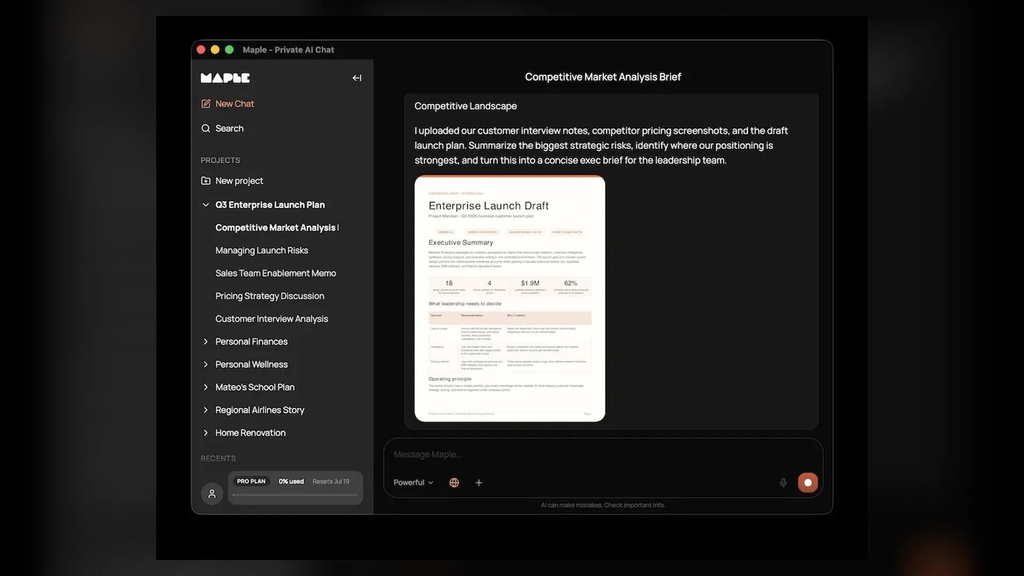
Maple is building a collection of products for individuals, businesses and developers rather than concentrating on a single chatbot.
| Product | Main purpose |
|---|---|
| Maple Chat | Private AI conversations, document analysis, writing and research |
| Maple Work | Desktop AI agent that can work with files, applications and browsers |
| Maple Teams | Shared private AI workspace for organisations |
| Maple Proxy | OpenAI-compatible endpoint for accessing private AI through existing tools |
Maple Chat
Maple Chat provides a familiar chatbot interface for users who want to ask questions, analyse documents, write content and conduct research.
Instead of depending on only one proprietary AI model, the platform supports several open models. TechCrunch reported that available options include versions of DeepSeek, Kimi, GLM, Inkling from Thinking Machines, Google’s Gemma and OpenAI’s GPT OSS.
Users can select models based on their requirements or use simpler options that switch between a faster model and a more powerful one.
The model selection gives Maple flexibility as new open-weight AI systems become available.
Maple Work
Maple Work is the company’s desktop AI agent. Unlike a conventional chatbot, it is designed to interact with a user’s computer and perform practical tasks.
It can work with selected project folders, files, applications and web browsers. The desktop product is available for Mac, Windows and Linux, according to Maple’s product information.
The application also includes integrations with services such as Gmail and calendars. Maple’s announcement describes potential business uses such as preparing reports from receipt folders, helping with chargebacks, reviewing contracts and analysing technical logs.
Maple Work can also launch a subagent inside compatible AI applications such as Claude and Codex, provided they support the Agent Client Protocol (ACP). This allows users to work with their preferred AI tools while limiting the information made available for a particular task.
The important difference is that Maple is attempting to combine the convenience of desktop AI agents with a more restrictive data-access model.
Maple Teams
Maple Teams is designed to bring the same privacy architecture into organisations.
Businesses increasingly want employees to use AI for research, document analysis, software development and operational tasks. However, they may be reluctant to upload confidential company information to services where they cannot independently verify how that data is handled.
Maple Teams aims to provide a shared AI environment while keeping company information under the organisation’s control.
Maple Proxy
Maple Proxy is intended for developers who want to connect existing applications and workflows to private AI infrastructure.
It provides an OpenAI-compatible endpoint, allowing developers to integrate supported models into tools without having to build an entirely separate AI interface.
This could help Maple reach businesses and developers that already have AI-powered applications but want stronger privacy protections.
Maple Plans to Launch a Cloud-Based AI Agent
One of the main products Maple plans to develop using its new funding is a cloud-based AI agent.
The existing Maple Work application operates as a desktop agent. A cloud-based version would allow tasks to continue even when the user’s computer is switched off.
This is an important development as AI agents increasingly move towards persistent, multi-step workflows.
For example, a cloud-based agent could potentially continue processing an assigned task, monitor a workflow or complete work that does not require the user to keep their computer running.
The planned product would also put Maple in more direct competition with consumer AI agents and other services that can carry out tasks over extended periods.
However, the cloud-based agent is a future development, not a feature that should be treated as already generally available.
Maple Reports 60-Fold Growth in Three Months
Maple said it has experienced 60-fold growth over the past three months as more users look for AI tools with stronger privacy protections.
The company’s announcement describes growth in daily encrypted AI usage. TechCrunch also reported the 60-fold growth figure, while noting that Maple declined to disclose its registered customer numbers.
The figure suggests increasing activity on the platform, but the company has not provided enough public information to calculate its total user base, revenue or market share.
Maple generates revenue through subscriptions. TechCrunch reported the following prices:
| Subscription plan | Reported monthly price |
|---|---|
| Pro | $20 |
| Max | $100 |
| Max Plus | $200 |
The subscription model is important because Maple says it does not sell user data to third parties or use private conversations to train AI models. Instead, the company intends to generate revenue through paid products and API services.
Founders Bring Experience From Apple, Security and Infrastructure
Maple was co-founded by Mark Suman and Anthony Ronning.
Suman is the company’s CEO and previously spent six years at Apple working on artificial intelligence, machine learning and computer vision. His experience included developing technology that could benefit from computer vision while protecting people’s identities and privacy.
Ronning is Maple’s CTO. He has a background in infrastructure, security, networking and defence technology. He originally started the company that later became Maple AI in 2023 as a privacy-focused fintech venture.
Suman joined Ronning in August 2024, when the idea for Maple AI took shape. The product became publicly available as a mobile application in January 2025.
The company is based in Austin and San Francisco and had a team of four at the time of TechCrunch’s report. It is now actively hiring.
Why Privacy-Focused AI Is Becoming a Bigger Startup Opportunity
The AI industry has largely focused on improving model performance, reducing inference costs and expanding the capabilities of AI assistants.
But as AI systems gain access to more personal and organisational information, privacy is becoming a major product and infrastructure challenge.
A chatbot may only need a question to generate an answer. An AI agent that manages email, reads documents, operates a browser or works with company software needs a much broader set of permissions.
This creates a potential conflict between usefulness and data security.
Businesses may want AI agents to review contracts, analyse internal records or investigate technical problems, but they may not be willing to expose those records to systems they cannot adequately audit.
Maple is betting that hardware-isolated processing, encryption and verifiable software can make it easier for these customers to adopt AI.
The opportunity is not limited to consumer chatbots. Private AI infrastructure could become relevant to financial services, legal firms, healthcare organisations, software companies and other businesses handling sensitive information. These are potential markets rather than confirmed Maple customer segments.
The Bigger Picture: AI Privacy Could Become a Competitive Advantage
Maple’s funding round highlights a growing distinction in the AI market: the ability to generate intelligent responses is no longer the only measure of a useful AI product.
As assistants become more capable, users also need to understand what information an AI system can access, where that information is processed and whether the provider can read or retain it.
Maple is attempting to make privacy part of the technical architecture rather than relying exclusively on company policies. Its use of open-source code and hardware attestation is intended to let customers examine how the system works.
That approach could appeal to individuals who want to use AI for sensitive personal tasks and businesses that need stronger controls over internal information.
The challenge will be making the technology easy to use, affordable and reliable while maintaining the security guarantees that differentiate the company.
What Happens Next?
Maple plans to use its $5.3 million seed funding to expand its team, improve its model infrastructure and develop Maple Work and Maple Teams. Its next major product milestone is a cloud-based AI agent that can continue working without requiring the user’s computer to remain switched on. The company is also preparing for enterprise pilots and completing SOC 2 compliance work and security audits ahead of a broader business push in 2027.
Maple is targeting a Series A funding round in the first half of 2027. Its ability to attract enterprise customers, demonstrate its privacy claims through independent verification and compete with larger AI platforms will be important to its next stage of growth. The larger question is whether verifiable privacy can become a mainstream requirement for AI products as agents gain access to increasingly sensitive information.
Frequently Asked Questions
1. How much funding has Maple raised?
Maple has raised $5.3 million in an oversubscribed seed funding round led by EPIC Ventures.
2. Who invested in Maple’s funding round?
The round was led by EPIC Ventures, with participation from Draper Associates, Planetary VC and Epoch VC.
3. What does Maple AI do?
Maple develops privacy-focused AI products, including a chatbot, desktop AI agent, enterprise workspace and developer API infrastructure.
4. How does Maple protect user data?
Maple encrypts information on the user’s device and processes it inside a hardware-isolated Trusted Execution Environment. The company says it cannot access users’ raw conversations and files.
5. What is a Trusted Execution Environment?
A Trusted Execution Environment is a hardware-supported secure computing area designed to isolate sensitive data and processing from the surrounding system.
6. Who founded Maple?
Maple was co-founded by Mark Suman, a former Apple engineer, and Anthony Ronning, who has experience in infrastructure, security and networking.
7. What is Maple Work?
Maple Work is a desktop AI agent that can interact with files, folders, applications and browsers to complete tasks on a user’s computer.
8. What will Maple do with the new funding?
The company plans to hire more employees, increase computing capacity, improve its AI products, develop a cloud-based agent and expand into enterprise customers.
9. Does Maple use customer conversations to train AI models?
Maple says it cannot read users’ conversations and therefore cannot use those conversations to train AI models. Its stated business model relies on subscriptions and API services rather than selling customer data.
Get the day’s top stories in your inbox
One concise email. No spam, unsubscribe anytime.


