
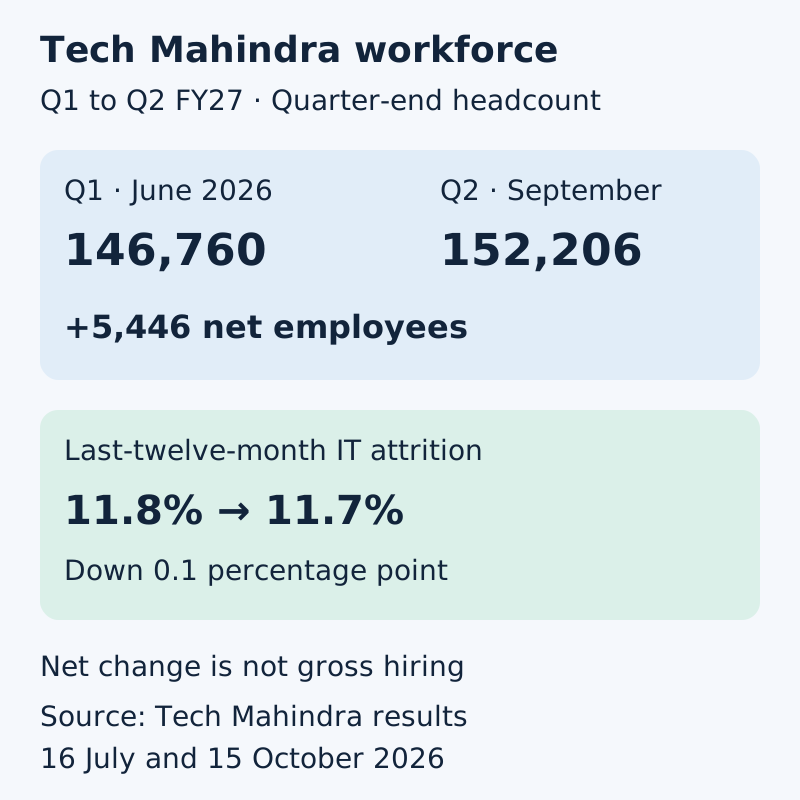
Tech Mahindra increased its workforce by 5,446 employees during the July–September 2026 quarter, taking its total headcount to 152,206 at the end of the second quarter of fiscal year 2026–27. The Pune-headquartered IT services company also reported a decline in its last-twelve-month (LTM) IT attrition rate to 11.7%, compared with 11.8% in the previous quarter. The figures point to workforce expansion alongside a slight improvement in employee retention.
The hiring increase comes as Tech Mahindra reports stronger financial performance and sustained deal activity. Consolidated revenue from operations rose 15.6% year-on-year to ₹16,180 crore, while profit after tax increased 32.7% to ₹1,586 crore. The company also reported more than $1 billion in deal wins in each of the last four quarters. However, the headcount increase alone does not reveal how many employees were newly hired, how many were replacing departing workers or which business units accounted for the expansion.
Key Takeaways
- Headcount increase: Tech Mahindra added 5,446 employees sequentially in Q2 FY27.
- Total workforce: The company ended September 2026 with 152,206 employees.
- Attrition falls: LTM IT attrition declined to 11.7% from 11.8% in Q1 FY27.
- Revenue growth: Consolidated revenue increased 15.6% year-on-year to ₹16,180 crore.
- Profit growth: Profit after tax rose 32.7% to ₹1,586 crore.
- Deal momentum: New deal wins reached approximately $1.02 billion during the quarter.
- Industry context: The increase provides a contrast with workforce reductions reported by some other major Indian IT services companies.
Tech Mahindra Adds 5,446 Employees in Q2 FY27
Tech Mahindra’s total headcount reached 152,206 at the end of the September 2026 quarter. The company had reported a workforce of 146,760 at the end of Q1 FY27, meaning its employee count increased by 5,446 over the three-month period.
| Workforce metric | Q2 FY27 |
|---|---|
| Closing headcount | 152,206 |
| Previous quarter’s headcount | 146,760 |
| Net sequential increase | 5,446 |
| LTM IT attrition rate | 11.7% |
| Previous quarter’s LTM IT attrition | 11.8% |
The sequential increase indicates that Tech Mahindra’s workforce expanded during the quarter. It does not necessarily mean the company hired exactly 5,446 people: net headcount reflects the combined effect of employees joining and leaving, along with other workforce movements.
The scale of the increase is notable because staffing decisions are closely linked to the IT services industry’s project pipeline. Companies need sufficient employees to deliver contracts, but they also need to control costs when client demand fluctuates.
Tech Mahindra’s latest figures suggest that it expanded its workforce while reporting strong year-on-year revenue and profit growth. Further details on hiring by business unit, geography and skill category would help explain where the additional capacity was deployed.
Attrition Rate Falls to 11.7%
Tech Mahindra’s LTM IT attrition rate declined to 11.7% in Q2 FY27 from 11.8% in the preceding quarter.
Attrition measures employee departures over a defined period. The LTM figure covers a rolling 12-month period, so it should not be interpreted as the percentage of employees who left during the September quarter alone.
The 0.1-percentage-point decline indicates a modest improvement in the reported attrition measure. Lower attrition can help IT services companies retain experienced employees, reduce recruitment and onboarding costs, and preserve continuity on client projects.
However, attrition is only one measure of workforce stability. Hiring levels, employee utilisation, skill availability, compensation and the balance between experienced staff and entry-level employees also influence the company’s staffing position.
The combination of lower attrition and higher headcount is consistent with workforce expansion, but the two metrics do not establish the exact number of new hires or explain the reasons employees stayed or left.
Why Lower Attrition Matters for IT Services Companies
IT services businesses depend on employees who understand client systems, industry requirements and complex technology projects. High employee turnover can disrupt delivery, increase training costs and make it harder to maintain project continuity.
A lower attrition rate can help companies retain institutional knowledge and reduce the pressure to replace experienced workers. It may also support productivity when employees remain with a client account or project for longer.
Nevertheless, a falling attrition rate does not automatically mean every part of a company is experiencing stronger retention. Employee departures can vary across service lines, job levels and locations, while the LTM measure can also change as older periods roll out of the calculation.
For Tech Mahindra, the next question is whether the improvement can be sustained while the company expands its workforce and invests in capabilities needed for future projects.
Strong Q2 Results Support the Workforce Expansion Story
Tech Mahindra’s workforce increase came alongside a stronger financial quarter. The company reported consolidated revenue from operations of ₹16,180 crore and profit after tax of ₹1,586 crore.
| Financial metric | Q2 FY27 | Year-on-year change |
|---|---|---|
| Revenue from operations | ₹16,180 crore | +15.6% |
| Profit after tax | ₹1,586 crore | +32.7% |
| New deal wins | Approximately $1.02 billion | +25.4% |
Revenue growth indicates that the company generated more business than in the corresponding quarter of the previous year. Profit grew faster than revenue, although a full assessment of the drivers requires examining operating costs, margins, tax expenses and other financial items.
The company also reported that its EBIT margin improved to 14.8%, with margins expanding for the twelfth consecutive quarter. Management maintained its 15% operating margin target for FY27, while highlighting a growing focus on business growth.
These figures provide useful context for the workforce increase. Stronger revenue and a healthy pipeline of new contracts can create demand for additional employees, particularly when projects move from the contract-award stage into implementation.
Still, quarterly financial growth does not prove that every additional employee was hired directly because of new deals. The timing of hiring, project mobilisation and revenue recognition can differ.
More Than $1 Billion in Deal Wins
Tech Mahindra reported approximately $1.02 billion in new deal wins during Q2 FY27, up 25.4% from a year earlier, according to Reuters.
Deal wins are an important indicator for IT services companies because they provide visibility into potential future work. Large contracts can require employees with specialised technical expertise, industry knowledge and experience managing complex implementations.
Tech Mahindra has been pursuing opportunities across communications, manufacturing, banking and financial services, and enterprise technology transformation. Revenue growth during the quarter included a 9.5% year-on-year increase in communications and 7% growth in manufacturing, while banking and financial services revenue rose 4.6%.
The company has also been integrating artificial intelligence into enterprise offerings. Management said almost all major recent deals included an AI component and that the company planned to report AI-related revenue in defined categories in the second half of FY27.
These developments may create demand for skills in AI implementation, data engineering, cloud modernisation, cybersecurity and enterprise integration. The number of employees needed will depend on contract size, project design, automation and how efficiently teams deliver the work.
Why Deal Wins Do Not Translate Directly Into Hiring
A large contract does not automatically lead to an immediate increase in headcount. Projects may be delivered using existing employees, redeployed teams, automation tools and a combination of onshore and offshore resources.
Revenue from a deal is also typically recognised over the delivery period rather than when the contract is signed. Hiring can therefore take place before a project begins, during implementation or only after demand becomes clearer.
Tech Mahindra’s combination of stronger deal wins and higher headcount is consistent with increased business activity, but the relationship cannot be quantified from these headline figures alone.
Tech Mahindra’s Hiring Trend in the Wider IT Sector
The workforce increase offers a different picture from headcount declines reported by some major Indian IT services peers during the same quarter. That contrast illustrates why employment trends should be assessed company by company rather than treating the entire sector as one market.
IT companies are navigating changing client budgets, productivity expectations and the adoption of AI-assisted software development and business processes. Some firms are reducing workforce numbers, while others are hiring selectively or redeploying employees to new projects.
The shift is not simply about the number of jobs available. The types of skills required are changing as companies build AI-enabled services, modernise older systems and help clients move experimental technology projects into production.
Tech Mahindra’s increased headcount does not prove that hiring conditions have improved across the entire Indian IT industry. It does, however, show that workforce expansion can occur alongside the broader industry’s efforts to improve productivity and adapt to changing demand.
For job seekers, the most useful indicators are sustained hiring, the types of roles being advertised and whether companies are investing in entry-level training. For employees, practical skills in cloud platforms, data, cybersecurity, AI integration and core software engineering can help prepare them for changing project requirements.
The Bigger Picture
Tech Mahindra’s addition of 5,446 employees in Q2 FY27, together with an LTM IT attrition rate of 11.7%, points to a quarter of workforce expansion and slightly improved retention. Its stronger revenue, profit growth and approximately $1.02 billion in deal wins provide business context for the increase, although they do not establish a direct one-to-one relationship between contracts and hiring.
The broader story is that workforce trends across India’s IT services industry are becoming more varied. Demand for technology services remains influenced by client budgets, AI adoption, project execution and cost pressures. Tech Mahindra’s ability to turn its growing workforce and deal pipeline into sustainable revenue and margins will be more important than headcount growth alone.
What Happens Next?
Investors will watch Tech Mahindra’s next quarterly headcount, attrition rate and deal wins to see whether workforce expansion continues. Revenue conversion, utilisation and operating margins will help show whether the additional capacity is being used efficiently. If hiring remains strong while profitability improves, it could indicate that the company is managing growth without losing cost discipline.
For employees and job seekers, the company’s results are a reminder that hiring conditions can differ significantly across IT services providers and skill categories. Tech Mahindra’s workforce increase is encouraging for the company’s staffing trajectory, but it does not guarantee that recruitment will continue at the same pace. Future hiring will depend on confirmed project demand, client spending and the skills required to deliver increasingly AI-enabled services.
Frequently Asked Questions
1. How many employees did Tech Mahindra add in Q2 FY27?
Tech Mahindra’s net headcount increased by 5,446 employees during the July–September 2026 quarter, taking its total workforce to 152,206.
2. What is Tech Mahindra’s attrition rate?
The company’s last-twelve-month IT attrition rate was 11.7% in Q2 FY27, down from 11.8% in Q1 FY27.
3. Why is Tech Mahindra increasing its headcount?
The increase coincided with revenue growth and approximately $1.02 billion in quarterly deal wins. These factors may support staffing needs, but the company has not attributed the entire headcount increase to a single cause.
4. Does lower attrition mean fewer employees left during Q2?
Not necessarily. The 11.7% figure is a trailing 12-month IT attrition rate, not a count of departures during Q2 alone. The quarterly net headcount change reflects both employees joining and employees leaving.
Get the day’s top stories in your inbox
One concise email. No spam, unsubscribe anytime.


