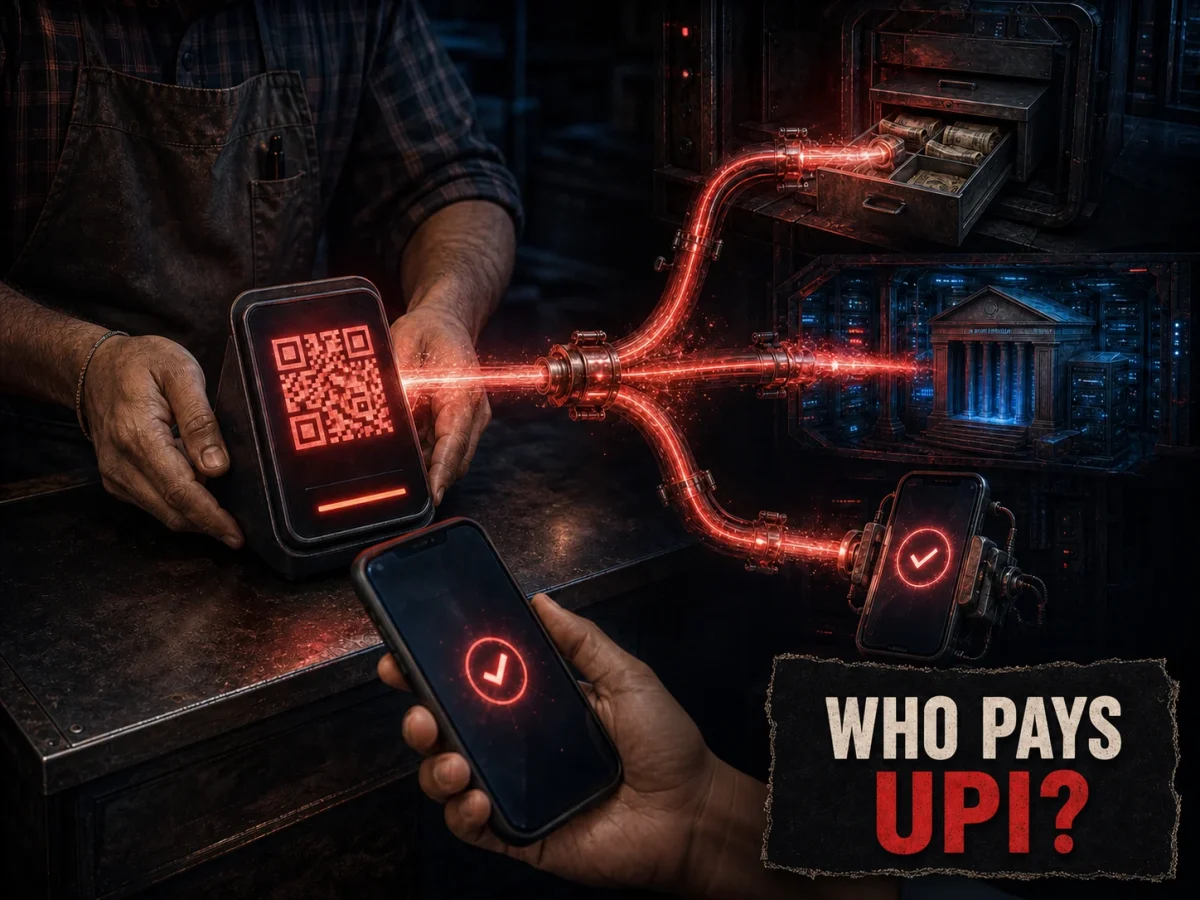
UPI charges face a merchant resistance problem before any new fee has been officially announced. A LocalCircles survey reported that 41% of merchants would not absorb any merchant discount rate (MDR) on UPI payments above ₹2,000, while only 17% would accept a charge of 0.3% or more.
Key takeaways
- LocalCircles collected 32,796 merchant responses; 41% rejected any MDR above ₹2,000 and another 9% said they do not accept UPI.
- Five in six surveyed merchants would not absorb a reported 0.3% rate, according to the survey findings.
- No official notification had fixed a 0.3% rate or ₹2,000 threshold when the survey was released.
- A merchant-side fee can still reach customers through higher prices, minimum transaction rules or a shift back to cash.
Everyone else is reporting that merchants dislike UPI MDR; we are explaining the fee-incidence problem. The policy question is not simply whether digital payments have a cost, but which participant can carry that cost without weakening merchant acceptance or pushing customers toward less traceable payment methods.
What the UPI charges survey actually found
India Today reported that the LocalCircles exercise collected 32,796 responses from merchants and businesses. For UPI transactions above ₹2,000, 41% said they would not bear any MDR and 9% said they do not accept UPI payments.
Among merchants willing to pay something, tolerance was fragmented. Fifteen percent selected 0.04%, 8% selected 0.25%, and smaller groups chose 0.1%, 0.2%, 0.5% or 1%. Only 17% in total were willing to absorb 0.3% or more.
The survey describes preferences, not measured behaviour after a rule change. It also does not establish that every response represents a unique merchant or that the sample perfectly matches India’s merchant population. Its value is directional: years of zero MDR have made free acceptance part of the expected UPI product.
| Merchant response | Share | What it suggests |
|---|---|---|
| Would absorb no MDR | 41% | High risk of refusal, pass-through or channel switching |
| Do not accept UPI | 9% | Already outside the acceptance base |
| Would accept 0.04% | 15% | Preference for a very small charge |
| Would accept 0.25% | 8% | Still below the reported 0.3% idea |
| Would accept 0.3% or more | 17% | Small minority at the reported level |
The categories in the table are condensed from the published survey breakdown. The full distribution also included 5% each at 0.1%, 0.2% and 0.5%, plus 12% at 1%.
UPI charges are still a proposal, not a notified rule
Reports have discussed a possible MDR of roughly 0.3% on selected higher-value merchant payments, sometimes using ₹2,000 as a threshold. No official order had confirmed that rate, threshold, merchant-turnover exemption or start date when the survey was published.
That distinction protects readers from a common error: treating a policy debate as a finished charge. Regular bank-account-to-merchant UPI payments remain within India’s zero-MDR framework. Different rules can already apply when a RuPay credit card, prepaid wallet or payment gateway is involved, so a merchant’s existing commercial arrangement should not be confused with a new universal UPI fee.
The legal foundation dates to Section 10A of the Payment and Settlement Systems Act. The Finance Bill’s official explanatory text described a prohibition on banks and system providers imposing charges, directly or indirectly, for prescribed electronic payment modes.
There is no officially notified blanket UPI charge for customers in the survey story. The debate concerns whether selected merchant transactions should fund part of the payment network through MDR, and any exact rate, threshold or exemption must come from the final legal text.
Why free UPI still has a real operating cost
Zero MDR does not make the payment rail costless. Banks, the National Payments Corporation of India (NPCI), payment service providers and merchant acquirers spend on transaction switching, fraud controls, reconciliation, dispute handling, cybersecurity, customer support and uptime.
A parliamentary committee report published in 2026 said government incentive support from 2021-22 through 2024-25 represented only 11% of the industry’s incurred cost and 14% of the potential MDR that could have been collected. The report argued that sustaining UPI expansion requires either a viable revenue mechanism or adequate budget support.
The scale explains why small rates produce large totals. NPCI’s official statistics show that UPI processed 22.716 billion transactions worth ₹28.92 lakh crore in June 2026. A fee applied only to merchant payments above a threshold would cover a smaller base, but even that subset could finance a meaningful share of network costs.
Lapaas Voice previously covered why payment aggregators want a defined share of UPI MDR. That industry demand explains one side of the debate: firms maintaining merchant payment infrastructure want predictable revenue rather than temporary incentives.
Who ultimately pays a merchant-side fee?
MDR is charged on the merchant side, but economic incidence can travel. A seller can absorb the fee through a smaller margin, spread it across all prices, set a minimum UPI amount, offer fewer discounts, ask for cash or attempt to add a convenience charge where rules permit.
Small businesses have less room to absorb a percentage fee when margins are thin. A 0.3% charge equals ₹6 on a ₹2,000 payment and ₹30 on a ₹10,000 payment. Those examples are arithmetic, not announced rates.
Large merchants may have more bargaining power and lower processing costs per transaction, but their total fee bill could be substantial. A turnover-based exemption could protect smaller sellers; it could also create a cliff where businesses just above the threshold face a new cost and gain an incentive to split transactions or under-report sales.
Customer behaviour could amplify the merchant response
The merchant survey followed a separate LocalCircles consumer survey. India Today reported that more than 45,000 responses across 322 districts indicated 53% of consumers would move away from UPI for higher-value transactions if MDR were passed on to them.
Among those responses, 27% preferred credit cards, 14% debit cards and 12% cash or bank transfer. Only 12% said they would pay the fee and continue with UPI, while 18% would continue if the merchant absorbed it.
Survey intentions are not the same as completed transactions, but the combination creates a warning. Merchants may resist absorbing a fee, while customers may resist paying it. A policy that ignores both reactions can reduce UPI acceptance precisely where the government wants digital payments to remain routine.
That risk should be balanced against UPI’s continuing product expansion. NPCI is working on features such as portable UPI AutoPay mandates, while providers are bringing UPI123 PAY to feature phones without internet. Funding the rail matters, but new charges should not reverse gains in access.
What a workable UPI charges policy would need
A durable framework would identify the problem before selecting a percentage. Policymakers must publish the eligible transaction base, the network cost being funded, the recipient of the fee and the treatment of incentives. Without that transparency, merchants may see MDR as a tax rather than payment for infrastructure.
Design choices could include protection for low-value payments, exemptions for small merchants, a capped charge, a flat fee rather than an open-ended percentage, or government support for inclusion-focused transactions. Each option shifts cost and behaviour differently.
Enforcement matters as much as the rate. The final rules would need to address merchant surcharges, transaction splitting, personal QR codes used for business payments and misleading claims that every customer must pay. Clear app and bank communication would reduce panic when policy headlines circulate.
The best evidence will arrive after implementation, if implementation occurs: acceptance rates, transaction values, cash substitution, merchant complaints and fraud patterns. Until then, the LocalCircles result is a strong signal of resistance, not a forecast that 41% of merchants will definitely stop accepting UPI.
What merchants and customers should do now
Merchants should not change prices or refuse ordinary bank-account UPI payments because of an unconfirmed headline. They should wait for an official notification, read the eligibility rules, and ask their acquiring bank or payment provider to identify any charge in writing. Existing fees on payment gateways, credit-card-on-UPI transactions or bundled business services may have a different legal basis.
A business can prepare by measuring its payment mix and average ticket size. If most sales are below a future threshold, the direct effect may be limited. If higher-value UPI payments dominate, the merchant should model the impact on gross margin, settlement cash flow and customer behaviour before choosing whether to absorb a permitted fee.
Customers should verify the amount displayed before entering a UPI PIN and challenge unexplained surcharges. They should distinguish a merchant’s price from a fee imposed by a bank or payment app, retain transaction records, and use official grievance channels when a charge appears inconsistent with published rules.
Frequently asked questions
Are UPI charges being introduced for every customer?
No blanket customer charge was officially notified in the survey report. The discussion concerns possible MDR on selected merchant payments, and the final legal text would determine the scope.
What did the UPI MDR survey find?
It found that 41% of merchant respondents would not absorb any MDR on UPI payments above ₹2,000. Only 17% would accept a rate of 0.3% or more.
What does MDR mean?
MDR means merchant discount rate. It is a payment-processing charge generally collected from the merchant side of a digital transaction.
Could merchants pass UPI MDR to customers?
They may try to recover it through prices, minimum transaction rules or payment preferences, subject to the final law and contract terms. A merchant-side fee does not automatically become a permitted customer surcharge.
Get the day’s top stories in your inbox
One concise email. No spam, unsubscribe anytime.


