
NVIDIA researchers are challenging one of the artificial intelligence industry’s biggest technical ambitions: building language models that can process increasingly large amounts of information in a single prompt. In a research paper titled You Don’t Need Long Context, the team argues that many AI tasks can be completed using much smaller working contexts, provided models regularly summarise their progress and retrieve information only when needed.
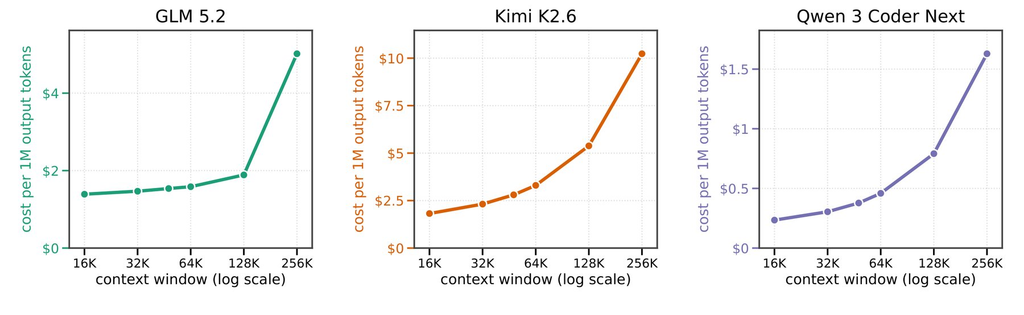
The study, submitted to arXiv on November 3, 2026, found that AI models could maintain broadly comparable performance on a range of long-running software engineering, information-seeking and document-analysis tasks while operating with significantly shorter contexts. The researchers also found that serving models with 256,000-token contexts instead of 16,000-token contexts could cost between 3.6 and seven times more per generated token in their tested cloud deployments. Their conclusion questions whether the industry’s race towards ever-larger context windows is the most effective way to improve AI systems.
Key Takeaways
- NVIDIA challenges the long-context race: Researchers argue that many AI tasks do not require enormous context windows.
- 16K–50K tokens can be sufficient: Frequent summarisation and selective retrieval helped models complete tasks using much shorter working contexts.
- Up to 7x serving-cost difference: Tested open-weight models cost 3.6 to seven times more per generated token at 256K contexts than at 16K.
- Long-running coding tasks still worked: Models maintained broadly comparable performance even when their conversation history was compressed frequently.
- Single-action experiments: Researchers found that agents could perform one action per context and continue using a compact semantic state.
- A proposed new architecture: The team introduced the concept of Semantic State Space Models, or SSSMs, for AI systems designed around compact, continuously updated memory.
Why NVIDIA Researchers Question Huge Context Windows
A context window is the amount of information an AI model can process at one time. It can include the user’s prompt, system instructions, previous messages, tool outputs, documents and other information required to generate a response.
Over the past few years, AI companies have significantly increased context-window limits. Models can now process hundreds of thousands or even more than one million tokens in a single interaction.
This capability is useful when users need to analyse lengthy documents, entire code repositories or extensive conversation histories.
However, NVIDIA’s researchers argue that the ability to process more information does not necessarily mean a model needs to keep all that information in its active context throughout a task.
For example, an AI coding agent working on a large software project may perform hundreds of actions. Its conversation history can grow as it reads files, runs commands, receives error messages and makes changes.
Instead of repeatedly sending the entire history back to the model, the agent could maintain a compact summary of its current progress and retrieve earlier information only when necessary.
The researchers believe this approach can reduce computational requirements without significantly damaging task performance.
Large Context Windows Can Be More Expensive
One of the strongest arguments in the paper concerns the cost of generating tokens when a model is working with a long context.
The researchers explain that later tokens are more expensive to generate because the model must process a larger amount of existing context. Longer contexts also increase memory requirements and can reduce generation speed.
To measure the financial impact, the team tested three open-weight models using NVIDIA H100 GPU deployments:
- GLM 5.2
- Kimi K2.6
- Qwen 3 Coder Next
The researchers compared serving costs at different context-window sizes.
| Model | Cost difference: 256K vs 16K context |
|---|---|
| GLM 5.2 | 3.6x |
| Kimi K2.6 | 5.6x |
| Qwen 3 Coder Next | 7x |
These figures represent the estimated cost of generating output tokens under the study’s tested serving conditions.
The researchers calculated the estimates using measured GPU throughput and an H100 rental price of $3.85 per GPU-hour.
The results suggest that reducing the amount of information maintained in active context could improve the economics of AI inference.
The study also measured local inference performance on an NVIDIA DGX Spark. For several tested models, token-generation latency approximately doubled as the input context increased across the measured lengths.
This matters for businesses operating AI systems at scale. Smaller working contexts could potentially allow the same hardware to serve more requests or generate responses faster.
AI Agents Can Work With Shorter Contexts Through Frequent Summarisation
The researchers tested whether AI agents could complete long-running tasks without retaining their entire conversation histories.
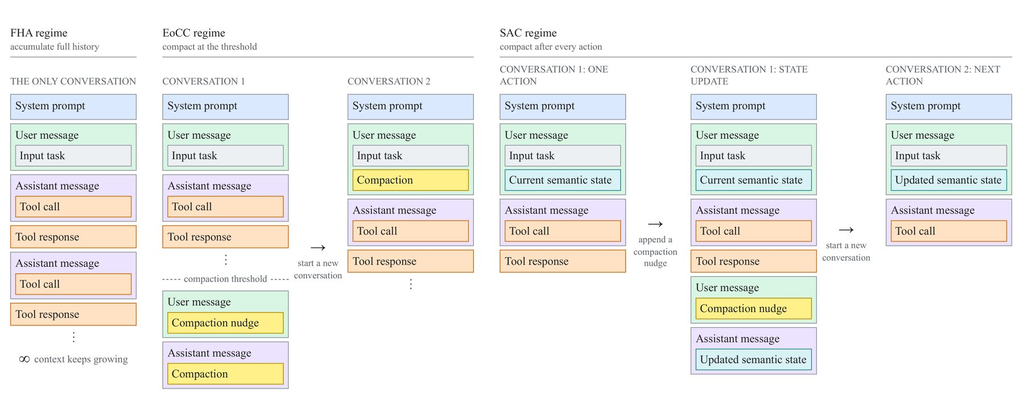
They compared three approaches to context management.
1. Full-History Accumulation
This is the conventional approach.
Every action taken by the AI agent and every response received from its environment are added to the same conversation.
As the task continues, the context becomes progressively larger.
Although this approach preserves the complete history, it can increase computational costs and slow down later interactions.
2. End-of-Conversation Compaction
Under this approach, the AI agent works normally until its conversation reaches a predefined length.
It then creates a summary containing the information needed to continue the task. A fresh conversation starts with the original task and this compressed state.
The process repeats whenever the context reaches the specified threshold.
The goal is to preserve important decisions, progress and outstanding work while removing unnecessary conversational history.
3. Single-Action Compaction
This is the more aggressive approach.
The model receives the original task and a compact description of its current state. It performs exactly one environment action, observes the result and updates its semantic state.
The conversation is then discarded, and a new model interaction begins.
This means the agent does not carry a growing conversation history from one action to another.
The researchers tested whether this extreme form of context management could still support complex software engineering tasks.
Coding Agents Maintained Performance With Smaller Contexts
The team evaluated long-running tasks using six benchmark suites, including software engineering, terminal operations, information retrieval and tool use.
Two frontier models were used in the main experiments:
- Anthropic Claude Opus 4.5
- GPT 5.6 Sol
The researchers found that frequent context compaction generally preserved performance across the tested long-horizon tasks.
For Claude Opus 4.5, performance changes ranged from a decline of 3.7 percentage points to an improvement of 5.6 points across the tested configurations.
For GPT 5.6 Sol, the range was a decline of 3.3 points to an improvement of 4.4 points.
The researchers also estimated cost savings from using shorter context configurations.
| Model | Estimated cost savings across tested configurations |
|---|---|
| Claude Opus 4.5 | 2.2x–8.8x |
| GPT 5.6 Sol | 2.4x–5.0x |
These are estimated savings across the study’s benchmark configurations, not guaranteed reductions for every AI application.
The results suggest that maintaining the entire history of an AI agent’s work may often be unnecessary.
An agent can preserve its important decisions and current progress in a compact summary rather than repeatedly processing every previous interaction.
What Happened When Agents Used Only One Action Per Context?
The researchers also tested Single-Action Compaction on two software engineering benchmarks: SWE-bench Verified and Terminal-Bench 2.1.
The approach required the agent to start a fresh context after every action, carrying forward only its updated semantic state.
The results were notable.
| Model | Benchmark | Full-history baseline | Single-action compaction |
|---|---|---|---|
| Claude Opus 4.5 | SWE-bench Verified | 70.0% | 70.2% |
| Claude Opus 4.5 | Terminal-Bench 2.1 | 47.2% | 51.8% |
| GPT 5.6 Sol | SWE-bench Verified | 84.4% | 82.4% |
| GPT 5.6 Sol | Terminal-Bench 2.1 | 87.6% | 84.3% |
Claude Opus 4.5 maintained its baseline performance on SWE-bench Verified and improved on Terminal-Bench.
GPT 5.6 Sol experienced relatively small declines on both benchmarks.
The amount of active context was also substantially reduced.
Under Single-Action Compaction, median peak context length was just 7,000–9,000 tokens across the two models and benchmarks. The maximum peak context fell from approximately 130,000–200,000 tokens in the full-history baseline to 15,000–37,000 tokens.
This experiment suggests that an AI agent does not necessarily need to retain its entire working history to perform the next step of a complex task.
Reading Large Documents Without Loading Everything Into AI Context
The study also examined tasks involving extremely long documents.
These included financial reports, legal cases, academic papers, code repositories and other collections of information.
Instead of placing entire documents inside the initial prompt, researchers stored them in the agent’s file environment.
The AI system could then use ordinary command-line tools such as sed, awk and head to inspect selected sections.
This approach allowed the agent to search for relevant information without loading every document into its active context.
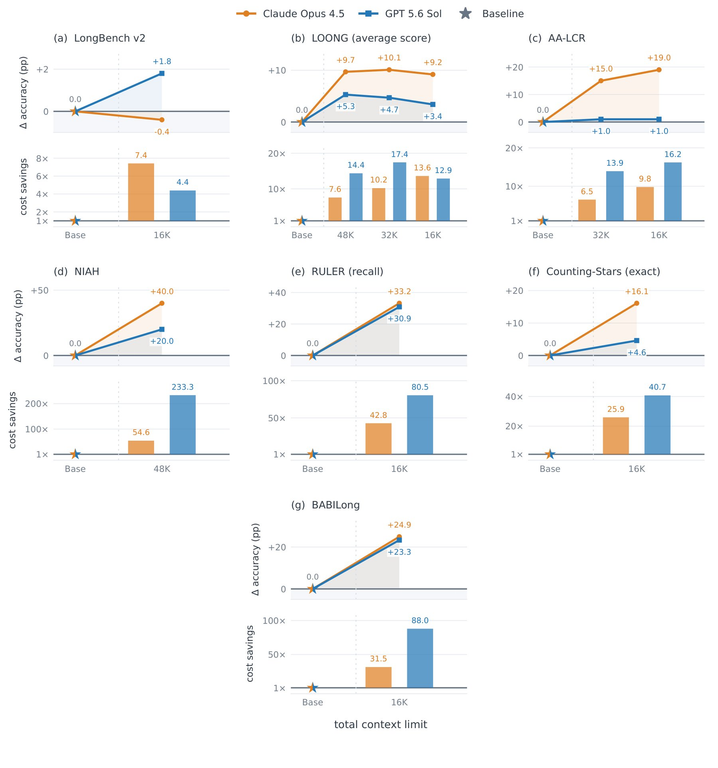
The researchers evaluated this method using seven long-input benchmarks, including LongBench v2, LOONG, Artificial Analysis Long Context Reasoning, RULER and BABILong.
For Claude Opus 4.5, performance changes ranged from a decline of 0.4 percentage points to an improvement of 40 points across the tested configurations.
For GPT 5.6 Sol, the measured improvements ranged from 1.0 to 30.9 percentage points.
The researchers also reported estimated cost savings of:
- Claude Opus 4.5: 6.5x to 54.6x.
- GPT 5.6 Sol: 4.4x to 233.3x.
These savings combine selective document reading with shorter context configurations. They should not be interpreted as savings from summarisation alone.
The findings suggest that a model may need access to a large document without needing to process the entire document simultaneously.
NVIDIA Proposes Semantic State Space Models
Based on the experiments, the researchers introduced a concept called Semantic State Space Models, or SSSMs.
The idea is to design AI models that maintain a compact, understandable description of their current state rather than relying on an ever-growing conversation history.
An SSSM would need to perform five operations:
- Understand a natural-language description of the current task state.
- Determine the next action or reasoning step.
- Perform that action.
- Register and interpret the outcome.
- Update its semantic state so another inference instance can continue the task.
The updated state would preserve important decisions, reasoning conclusions, actions and results.
Unlike traditional state-space models that maintain an internal numerical representation, the proposed SSSM concept uses an explainable natural-language state.
This could make it easier for different model instances to continue a task without needing access to every previous interaction.
However, SSSMs remain a proposed research direction in this paper. The authors have not demonstrated a fully developed commercial model implementing the complete concept.
The Bigger Picture
The AI industry has increasingly treated context-window size as a measure of model capability. Larger windows allow models to accept more information, making them attractive for coding agents, research assistants and enterprise applications.
NVIDIA’s research challenges the assumption that more context automatically produces better results.
The study suggests that AI systems could become more efficient by separating information storage from active reasoning. Instead of repeatedly processing entire histories and documents, models could maintain concise working states and retrieve specific information when necessary.
This approach also changes how developers may design AI agents. Better memory management, structured summaries and reliable retrieval could become just as important as increasing the maximum number of tokens a model can accept.
However, long context is not useless. Certain tasks require exact access to extensive information, and summarisation can lose details. The paper explicitly acknowledges that some workloads may benefit from longer contexts.
What Happens Next?
The next step will be determining whether the findings can be reproduced across more models, applications and real-world workloads. The research demonstrates promising results with Claude Opus 4.5, GPT 5.6 Sol and several open-weight models, but it is a technical preprint rather than a peer-reviewed study. Its results also depend on the benchmark environments, compaction methods and retrieval tools used in the experiments.
For AI developers, the research offers a different direction for improving agent performance. Rather than relying entirely on larger context windows, future systems could combine compact working memory, selective document retrieval and structured state updates. If these techniques continue to deliver comparable accuracy at lower serving costs, the industry’s focus could gradually shift from how much information an AI model can hold at once to how efficiently it remembers and uses what matters.
Get the day’s top stories in your inbox
One concise email. No spam, unsubscribe anytime.


